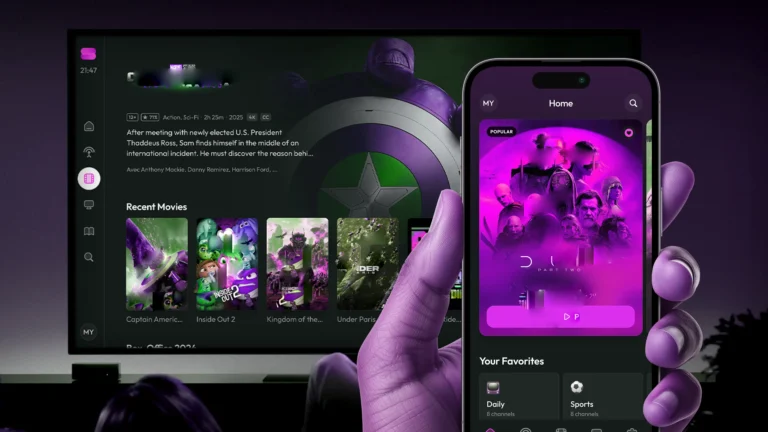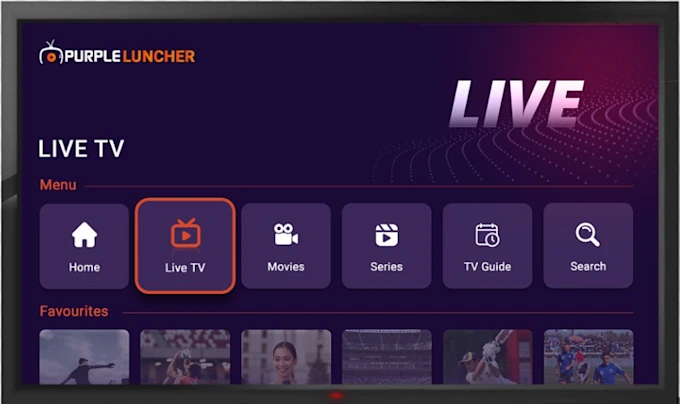



Choosing an IPTV Solutions in 2026 is no longer only about finding a service that provides a large number of television channels. A complete IPTV setup combines several elements: a reliable internet connection, suitable streaming infrastructure, a compatible device, an IPTV player, accurate program information, and a service that can maintain stable performance when demand is high.
Internet Protocol Television delivers video through internet-based networks instead of relying only on traditional cable, satellite, or terrestrial broadcasting. This approach gives viewers more flexibility because the same IPTV service can often work across smart televisions, streaming boxes, smartphones, tablets, and computers.
However, not every IPTV setup performs equally well. Two users can subscribe to the same service and have completely different experiences because their Wi-Fi quality, device performance, player configuration, and internet routing may differ.
A good IPTV streaming solution therefore needs to be evaluated as a complete ecosystem.
In this 2026 guide, you will learn:
- What an IPTV solutions actually includes
- How IPTV travels from a source to your screen
- Why servers and content delivery networks matter
- Which features determine IPTV reliability
- Which devices can be used for IPTV streaming
- How much internet speed you really need
- Why bandwidth alone does not guarantee smooth playback
- How to distinguish a reliable IPTV setup from a poorly optimized one
Useful principle: The best IPTV experience normally comes from the combination of a reliable service, a capable device, a stable network, and correct configuration—not from one component alone.
What Is an IPTV Solutions?
An IPTV solutions is a complete technology system used to deliver television channels, video, and other multimedia content over an IP-based network.
The term IPTV stands for Internet Protocol Television.
Instead of sending television signals through a traditional satellite dish or cable television network, IPTV delivers video data using internet protocols. The television content is transformed into digital streams, delivered through network infrastructure, processed by an application or IPTV player, and finally displayed on the user’s television or other supported device.
This allows IPTV technology to support more than conventional live television.
Depending on the platform, an IPTV environment can include:
- Live television
- Video on demand
- Movies
- Series
- Electronic Program Guides
- Catch-up functionality
- Multi-device viewing
- Search functions
- Favorite channel lists
- Parental controls
- Multiple audio tracks
- Subtitle support
But IPTV should not be viewed simply as an application or playlist.
A professional IPTV setup includes several systems working together.
IPTV Meaning Explained Simply
Imagine traditional television as a continuous broadcast.
A broadcaster sends the signal, and every viewer receiving that signal can watch whatever is being transmitted at that moment.
IPTV works differently.
When you select a channel or piece of content, your device sends a request through the network. The IPTV infrastructure then provides the requested stream to your player.
The simplified process looks like this:
Content source → Encoding → Streaming infrastructure → Internet → IPTV player → Device → Screen
This on-demand relationship between the viewer and the network is one reason IPTV systems can offer much greater flexibility than traditional television distribution.
For example, IPTV platforms may allow viewers to change channels quickly, browse program schedules, access on-demand libraries, or continue viewing across multiple supported devices.
Organizations such as the OECD have discussed IPTV as part of the broader evolution of television distribution through IP networks, highlighting how internet-based delivery changed the relationship between telecommunications and traditional broadcasting.
The important distinction is that IPTV describes a delivery technology. The quality and legality of an individual IPTV service depend on how that particular service operates and whether it has authorization to distribute the content it provides.
The Components of a Complete IPTV Solutions
A useful way to understand IPTV is to separate the system into several layers.
| Component | Main purpose | Why it matters |
|---|---|---|
| IPTV service | Provides access to television or video content | Determines content availability and service reliability |
| Streaming infrastructure | Processes and distributes streams | Affects stability and response time |
| Internet connection | Carries video data to the viewer | Insufficient or unstable connectivity can cause buffering |
| IPTV player | Reads and displays the stream | Affects navigation and playback compatibility |
| Streaming device | Runs the IPTV application | Hardware limitations can affect performance |
| EPG | Displays schedules and program information | Makes channel navigation easier |
| Network hardware | Connects the device to the internet | Router quality can affect stability |
| Customer support | Helps users solve service or setup issues | Important when technical problems occur |
One mistake many users make is blaming every streaming problem on the IPTV provider.
Sometimes the provider is responsible.
But many playback problems are actually caused by the user’s network.
A weak Wi-Fi signal, overloaded router, outdated IPTV application, limited device memory, or network congestion can all reduce playback quality.
That is why a reliable IPTV solutions should be evaluated from end to end.
How Does an IPTV Solutions Work?
IPTV might appear simple from the viewer’s perspective.
You open an application, choose a channel, and the video begins.
Behind that simple action is a complicated chain of systems.
Understanding this chain helps explain why IPTV streams sometimes start immediately and why other streams may buffer, freeze, or take longer to load.
From Source to Screen
A typical IPTV delivery process contains several stages.
1. Content acquisition
The process begins with the original video source.
This might be:
- A television broadcast
- A live event
- A digital video feed
- A licensed media library
- On-demand content
The original content must be collected before it can be delivered to viewers.
2. Video encoding
Raw video can require a very large amount of data.
Encoding compresses the video into a format that can be transmitted efficiently across networks.
Modern streaming platforms may prepare several versions of the same content at different resolutions or bitrates.
For example:
| Version | Typical use |
|---|---|
| Lower bitrate | Slower connections or smaller screens |
| Standard quality | Moderate connections |
| HD | Most modern televisions |
| Full HD | Larger displays and stronger connections |
| 4K | High-resolution displays and higher bandwidth |
Compression is extremely important.
Without effective compression, internet video would require much more bandwidth.
3. Stream preparation
The encoded video is divided into smaller pieces that can be delivered through the network.
Breaking the stream into manageable segments makes internet video delivery more flexible.
If network conditions change, some streaming systems can also change video quality to maintain playback.
4. Distribution
The video is then distributed through streaming infrastructure.
Large video platforms frequently use geographically distributed servers or content delivery networks to reduce the distance between the user and the data.
This can improve:
- Start-up time
- Stream stability
- Latency
- Server scalability
- Peak-demand performance
5. Internet transmission
The video travels across network infrastructure toward the viewer.
Several networks may be involved before the data reaches the home router.
That means streaming quality can sometimes be influenced by factors outside both the IPTV provider and the viewer’s home.
6. Home network
The video reaches the router.
From there, it may travel through:
- Ethernet
- Wi-Fi
- Mesh Wi-Fi
- Mobile connectivity
The quality of this final connection is extremely important.
7. IPTV player
The IPTV application receives the video stream, buffers a small amount of content, decodes the video, and displays it.
8. Television or device
Finally, the device renders the video on the screen.
If you want a deeper explanation of how IPTV streaming delivery works, see our IPTV stream guide.
Live Streaming vs Video on Demand
Live IPTV and video on demand use similar internet technologies, but the viewer experience is different.
With live streaming, content is being delivered while the event or program is happening.
Examples include:
- Live television
- News
- Sports
- Events
Because the viewer is receiving content close to real time, the delivery system has less flexibility to recover from network problems.
This is why live television may expose poor network conditions faster than prerecorded content.
With video on demand, the content already exists on the server.
The player can often buffer more content in advance.
This makes on-demand playback more tolerant of short internet fluctuations.
Consider this simplified comparison:
| Feature | Live IPTV | Video on demand |
|---|---|---|
| Content timing | Real time | Pre-recorded |
| Buffering tolerance | Lower | Usually higher |
| User controls | Often limited | Usually pause/seek available |
| Network sensitivity | Higher | Moderate |
| Delivery delay | Important | Less important |
This explains why a connection might play a movie perfectly but experience interruptions during a live broadcast.
Why Servers and CDN Infrastructure Matter
One of the most important parts of an IPTV infrastructure is its server architecture.
If thousands of viewers try to access the same server simultaneously, that server has to process a significant amount of traffic.
Poorly designed infrastructure can become overloaded.
Common symptoms include:
- Longer channel loading times
- Buffering
- Temporary freezes
- Reduced video quality
- Connection failures
- Poor peak-hour performance
A Content Delivery Network, commonly called a CDN, helps distribute content across multiple locations.
Instead of forcing every user to request the same stream from one distant location, a CDN can deliver cached or distributed content from infrastructure closer to users.
This approach is widely used across the modern internet by:
- Streaming platforms
- News websites
- E-commerce sites
- Software distribution networks
- Social platforms
- Video services
For IPTV, network distribution can help reduce the workload placed on a single origin server.
However, a CDN alone cannot guarantee perfect streaming.
Performance also depends on:
- Stream encoding
- Server capacity
- Internet routing
- User location
- ISP congestion
- Home network
- Playback device
That is why claims such as “zero buffering” should be treated carefully.
No internet-based streaming technology can control every network between the server and the viewer.
What Makes a Good IPTV Solutions?
A reliable IPTV solutions in 2026 should be judged using practical performance criteria.
Channel count alone is not enough.
A service offering thousands of channels is not necessarily better than one offering fewer channels with more consistent playback, better organization, and stronger technical support.
The most important qualities usually include stability, video quality, compatibility, usability, and customer support.
Streaming Stability
Stability is one of the most important IPTV performance indicators.
A stable stream should:
- Start within a reasonable time
- Continue playing without frequent interruption
- Recover correctly after minor connection changes
- Remain usable during busy viewing periods
An IPTV service might perform perfectly when network demand is low but struggle during popular evening viewing periods.
Therefore, evaluating an IPTV service only during a short daytime test may not provide the complete picture.
A more useful test includes different conditions.
Practical stability test
Try the service:
- During daytime
- During evening peak hours
- On several channels
- On both live and on-demand content
- Using Wi-Fi
- Using Ethernet where possible
This helps distinguish a service problem from a local network problem.
Short Case Study: The “Fast Internet but Buffering” Problem
Consider a household with a 500 Mbps internet plan.
On paper, this is far more bandwidth than required for one IPTV stream.
Yet the television buffers every few minutes.
The user assumes the IPTV provider is the problem.
Testing reveals:
- Internet connection: 500 Mbps
- TV Wi-Fi speed: 28 Mbps
- Router location: two rooms away
- Wi-Fi band: congested 2.4 GHz
- Ethernet test: stable
After connecting the television through Ethernet, buffering disappears.
The lesson is important:
Your internet subscription speed and the actual connection reaching your streaming device are not always the same thing.
This is why IPTV troubleshooting should always examine the complete network path.
Video Quality
A quality IPTV service may offer several video resolutions depending on the channel, source, device, and subscription.
Common resolutions include:
- SD
- HD
- Full HD
- 4K
But resolution should not be confused with overall image quality.
A poorly encoded 4K stream can sometimes look worse than a high-quality Full HD stream.
Several factors influence perceived video quality:
- Resolution
- Bitrate
- Compression
- Frame rate
- Source quality
- Display quality
- Network stability
For example, fast-moving sports content generally requires more data than a static news broadcast to maintain the same perceived image quality.
High motion creates more changes between video frames.
That can make sports particularly demanding for compression systems.
Therefore, users interested in high-motion content should evaluate not only resolution but also motion clarity and playback stability.
Fast Channel Switching
Channel switching time is another useful IPTV quality indicator.
When a user selects a new channel, several things happen:
- The previous stream is stopped.
- The new stream is requested.
- The server begins delivering data.
- The player fills its initial buffer.
- Video decoding begins.
- The picture appears.
A short delay is normal.
However, very long loading times may indicate:
- Server congestion
- Poor routing
- Slow device hardware
- Application problems
- Weak network connectivity
A powerful streaming device can also make the interface feel more responsive.
This is why IPTV performance cannot be judged exclusively by the subscription itself.
Electronic Program Guide
An Electronic Program Guide, or EPG, displays information about scheduled television programming.
A useful EPG may show:
- Current program
- Upcoming program
- Start time
- End time
- Program description
- Channel information
Without a working EPG, navigating hundreds of television channels can become frustrating.
EPG quality depends on both data availability and correct synchronization.
Common EPG problems include:
- Incorrect time zones
- Missing program information
- Outdated schedules
- Mismatched channel IDs
- Failed EPG updates
A reliable IPTV environment should therefore treat program information as part of the overall user experience.
Multi-Device Compatibility
One of IPTV’s strongest advantages is flexibility.
A modern IPTV streaming solution may support multiple types of devices.
Common options include:
- Smart TVs
- Android TV
- Google TV
- Streaming boxes
- Smartphones
- Tablets
- Windows computers
- Mac computers
However, device compatibility should always be checked before purchasing a long subscription.
Not every application works on every operating system.
Some televisions also have limited processing power compared with dedicated streaming boxes.
That difference becomes important when users run:
- Large playlists
- Complex interfaces
- High-resolution streams
- EPG databases
- Multiple applications
Customer Support
Technical support is often overlooked until something stops working.
A trustworthy service should provide a clear way to contact support.
Good support should be able to help users distinguish between:
- Account problems
- Application problems
- Device problems
- Connection problems
- Service problems
Support should not simply tell every customer to restart the router.
A structured troubleshooting process is more useful.
For example:
Question 1: Does the problem affect every channel?
Question 2: Does the problem occur on multiple devices?
Question 3: Does another internet video platform work correctly?
Question 4: Does the problem continue over Ethernet?
These questions quickly help isolate the source.
IPTV Solutions Device Compatibility
Device selection can significantly affect the quality of an IPTV solutions.
A powerful service cannot compensate for severely outdated hardware.
Similarly, an expensive streaming box cannot fix an unreliable internet connection.
The best results usually come from balancing hardware, network quality, and software compatibility.
IPTV Solutions for Smart TV
Smart televisions are convenient because they can run streaming applications without requiring another device.
Potential advantages include:
- Fewer cables
- One remote control
- Simple setup
- Direct app installation
- No separate streaming hardware
However, smart TVs often have less memory and processing power than dedicated media boxes.
Older televisions may also stop receiving application updates.
Before using IPTV directly on a smart television, check:
- Operating system
- App availability
- Available storage
- Software update status
- Ethernet support
- Wi-Fi capabilities
If the television becomes slow when loading large playlists or EPG data, a separate streaming device may provide better performance.
IPTV Solutions for Android TV and Google TV
Android TV and Google TV devices are widely used for IPTV because they support a large ecosystem of streaming applications.
Advantages may include:
- Flexible application selection
- Frequent software updates
- Bluetooth support
- External storage on some devices
- Ethernet support on compatible hardware
- Strong multimedia compatibility
Performance still varies between devices.
Entry-level hardware may struggle with large IPTV libraries or demanding 4K playback.
Higher-performance devices usually offer:
- Faster processors
- More RAM
- Better Wi-Fi
- Improved video decoding
- Faster menus
IPTV Solutions for Streaming Boxes
A dedicated streaming box can be a good option when the television’s built-in system is slow or limited.
A capable IPTV box may provide:
- Faster application performance
- Better network connectivity
- More storage
- Better video decoding
- Broader player compatibility
Before buying one, evaluate:
| Feature | Why it matters |
|---|---|
| Processor | Affects navigation and decoding |
| RAM | Helps applications run smoothly |
| Storage | Important for apps and cached data |
| Ethernet | Provides stable wired connectivity |
| Wi-Fi standard | Important when Ethernet is unavailable |
| Video codec support | Determines playback compatibility |
| Software updates | Helps maintain security and compatibility |
For more detail, see our guide to choosing a good IPTV box.
IPTV on Smartphones and Tablets
Smartphones and tablets can provide a convenient portable IPTV experience.
They are useful when:
- Watching away from the main television
- Testing a subscription
- Troubleshooting a device
- Using mobile connectivity
- Moving between rooms
Mobile devices can also help diagnose IPTV problems.
For example, if IPTV works correctly on a smartphone using the same Wi-Fi network but performs poorly on the television, the problem may be related to the television, application, or device hardware rather than the IPTV service.
That simple comparison is extremely useful during troubleshooting.
IPTV on Windows and Mac
Computers can also provide a flexible IPTV environment.
Benefits include:
- Larger processing capacity
- Easy network testing
- Multiple player options
- Ethernet availability
- Simple troubleshooting
Computers are especially useful when checking whether a playback issue originates from the IPTV service or the primary television device.
If a stream fails on several independent devices connected through different networks, the probability of a server-side problem becomes higher.
Internet Speed Requirements for IPTV
Internet speed is one of the most discussed IPTV topics, but it is also frequently misunderstood.
The speed printed on your internet plan represents the maximum or expected capacity available under certain conditions.
It does not necessarily represent the bandwidth reaching your television.
A user might have a 300 Mbps internet package while receiving only 15 Mbps on a television connected through weak Wi-Fi.
For IPTV, stable bandwidth is often more important than very high peak speed.
A practical starting point for a single stream is:
| Streaming quality | Practical connection target |
|---|---|
| SD | 5+ Mbps |
| HD | 10+ Mbps |
| Full HD | 15–25 Mbps |
| 4K | 25+ Mbps |
| Multiple streams | Additional capacity per active stream |
These figures should be treated as practical guidelines, not universal guarantees.
Actual requirements depend on:
- Encoding
- Bitrate
- Frame rate
- Player
- Device
- Streaming platform
- Network overhead
For example, two Full HD streams do not necessarily use exactly the same bandwidth.
One could consume significantly more data because it uses a higher bitrate.
Ethernet vs Wi-Fi for IPTV
For a stationary television, Ethernet is usually the most reliable connection option when available.
Ethernet provides several advantages:
- Lower interference
- More predictable latency
- Consistent throughput
- Less dependence on router location
- Fewer signal-strength problems
Wi-Fi is more convenient, but it depends heavily on the environment.
Walls, furniture, neighboring wireless networks, appliances, and router placement can all affect performance.
That does not mean IPTV cannot work well over Wi-Fi.
Modern Wi-Fi networks can deliver excellent streaming performance.
But when diagnosing unexplained buffering, an Ethernet test is one of the most valuable troubleshooting steps.
2.4 GHz vs 5 GHz Wi-Fi
Many routers broadcast both 2.4 GHz and 5 GHz wireless networks.
The difference matters for IPTV.
| Wi-Fi band | Main advantage | Main limitation |
|---|---|---|
| 2.4 GHz | Longer range | More interference and lower speeds |
| 5 GHz | Higher speeds and less congestion | Shorter effective range |
| 6 GHz on supported devices | High capacity and low interference | Shorter range and requires compatible hardware |
The 2.4 GHz band can travel farther through walls.
However, it is heavily used by many household devices.
The 5 GHz band can often provide better performance for streaming when the device is reasonably close to the router.
A television located near the router may therefore perform better on 5 GHz.
A television far away may have a stronger signal using 2.4 GHz even though the theoretical speed is lower.
The correct choice depends on the physical environment.
Why Speed Tests Don’t Tell the Whole Story
A speed test is useful, but it measures only part of network quality.
An IPTV stream is affected by several other factors.
Latency
Latency measures how long data takes to travel through the network.
Lower latency generally produces faster response times.
Packet loss
Internet data is divided into packets.
If packets are lost during transmission, video playback can become unstable.
Jitter
Jitter describes variation in packet arrival time.
High jitter can create problems for real-time applications.
Congestion
Networks can become busy during peak hours.
Your internet speed might be excellent in the morning but less stable in the evening.
Wi-Fi interference
Nearby wireless networks may use the same radio channels.
This can reduce performance even when the internet connection itself is fast.
Router limitations
Older routers may struggle when many devices are simultaneously:
- Streaming video
- Downloading files
- Playing online games
- Making video calls
- Backing up data
Example
Imagine this household:
- IPTV television: 20 Mbps
- Laptop downloading game: 150 Mbps
- Two phones streaming video: 15 Mbps each
- Cloud backup: 100 Mbps
- Video call: 8 Mbps
The household may be consuming more than 300 Mbps.
Even with a fast internet package, the router must manage all of this traffic correctly.
Therefore, when diagnosing IPTV buffering, ask:
What else is using the network at the same time?
That simple question often reveals the cause.
IPTV Network Quality Checklist
Before blaming the IPTV service, perform this short test:
- Restart the router
- Restart the IPTV device
- Test another streaming application
- Run a speed test near the television
- Run a speed test directly on the device if possible
- Disconnect unnecessary devices temporarily
- Test 5 GHz Wi-Fi
- Test Ethernet
- Update the IPTV application
- Update the streaming device
- Compare several channels
- Test again during another time of day
If the issue disappears over Ethernet, the home wireless network probably deserves closer attention.
If the issue remains on several devices and several networks, the streaming source or service infrastructure becomes a more likely cause.
How to Set Up an IPTV Solutions Step by Step
Setting up an IPTV solutions in 2026 should be approached as a simple technical process rather than just installing an application and entering account details. A successful setup depends on the connection, device, IPTV player, service credentials, program guide configuration, and final performance testing. Taking a few minutes to verify each component can prevent many of the buffering, login, EPG, and playback problems users experience later.
The exact menus differ between televisions, streaming boxes, smartphones, and computers, but the underlying process remains similar.
The most reliable setup order is: Network → Device → Player → Service → EPG → Playback Test → Peak-Hour Test.
Step 1: Confirm Your Internet Connection
Before installing anything, make sure the streaming device has a reliable internet connection.
Do not rely only on the speed shown in your broadband package. What matters is the actual connection reaching the device that will play IPTV.
For example, a household may have a 500 Mbps broadband subscription, while an older television located far from the router receives only 20–30 Mbps over Wi-Fi.
Start by checking:
- Whether the device is connected to the correct network
- Wi-Fi signal strength
- Whether 5 GHz Wi-Fi is available
- Whether Ethernet can be used
- Whether other devices are heavily using the connection
- Whether normal internet video plays correctly
- Whether the router has recently been restarted
For a stationary television, testing with Ethernet is particularly valuable because it removes many Wi-Fi variables from the troubleshooting process.
If normal streaming services also buffer, the IPTV subscription may not be the first thing to investigate.
Step 2: Choose a Compatible Device
The next step is selecting hardware that can comfortably handle your preferred viewing quality.
A modern IPTV streaming solution may work with:
- Smart TVs
- Android TV
- Google TV
- Streaming boxes
- Smartphones
- Tablets
- Windows PCs
- Mac computers
However, “compatible” does not always mean “optimal.”
An old Smart TV might technically run an IPTV player but have insufficient memory for a large EPG database or a complex channel list. A newer streaming box may handle the same service much more smoothly.
Before choosing the device, consider:
| Requirement | What to check |
|---|---|
| HD playback | Hardware video decoding |
| 4K playback | 4K-compatible device and display |
| Large channel lists | Sufficient RAM and processing power |
| Wi-Fi streaming | Modern wireless support |
| Stable fixed setup | Ethernet availability |
| EPG use | Enough memory/storage |
| Long-term usability | Software update support |
A device that receives regular software updates is generally preferable to one that has reached the end of its support life.
If your television’s built-in operating system is slow or restrictive, a dedicated streaming device can sometimes provide a much better experience. Our guide to choosing a good IPTV box explains the hardware considerations in more detail. IPTV box guide
Step 3: Choose a Compatible IPTV Player
An IPTV player is the software interface used to load and display your IPTV service.
The player itself normally does not create television content. It acts as the application that communicates with a compatible service and organizes the information provided to it.
Depending on the service and device, authentication methods may include:
- Account-based login
- Provider-issued credentials
- Compatible playlist formats
- Portal-based connections
- Other authorized configuration methods supported by the provider
A good player should make everyday viewing easier.
Useful features can include:
- Fast navigation
- Search
- Favorites
- EPG integration
- Subtitle controls
- Audio-track selection
- Parental controls
- Recently watched content
- Multiple profiles
- Playback controls
- Clear error messages
Avoid downloading applications from unknown websites when an official app store or developer source is available.
A player should also receive updates. Updated software can fix crashes, improve decoding, resolve compatibility problems, and address security vulnerabilities.
Step 4: Obtain Your Service Credentials
Once your network, device, and player are ready, obtain the official account information provided by your IPTV service.
Depending on the provider, this could include:
- Username
- Password
- Server information
- Activation information
- Account identifier
- Supported configuration method
Keep these credentials private.
Do not publicly share screenshots containing usernames, passwords, subscription URLs, QR codes, or account information. Someone who obtains valid credentials may be able to use the account or interfere with your subscription.
A trustworthy service should also explain:
- Subscription duration
- Supported devices
- Number of simultaneous connections
- Renewal rules
- Support contact
- Setup instructions
If important account conditions are unclear before purchase, ask the provider before committing to a long subscription.
Step 5: Add Your Account to the Player
Open the selected IPTV player and choose the login or account-addition option supported by your provider.
Enter the credentials carefully.
A large percentage of login failures come from simple input errors such as:
- Extra spaces
- Incorrect capitalization
- Confusing
0withO - Confusing
1withI - Old credentials
- Incorrect server information
- Expired subscription information
If possible, copy and paste credentials rather than typing long values manually.
After successful authentication, allow the player enough time to load the available categories and program information.
Large libraries can take longer to initialize on slower devices.
Step 6: Configure EPG and Playback Preferences
Once the service is loaded, configure the interface before beginning regular viewing.
Important settings may include:
- EPG refresh
- Time zone
- Preferred language
- Audio track
- Subtitle behavior
- Hardware decoding
- Player engine
- Buffer settings
- Parental controls
- Favorite channels
The EPG time zone is particularly important.
If the EPG displays programs one or two hours earlier or later than expected, the underlying schedule may be correct while the application is applying the wrong time-zone offset.
Do not immediately assume the provider’s EPG is broken.
First check:
- Device time
- Device time zone
- IPTV player time-zone settings
- Automatic daylight-saving settings
- EPG refresh
Step 7: Test Streaming Quality
Do not evaluate an IPTV service using only one channel.
A better test should include several types of content.
For example:
| Test | What it reveals |
|---|---|
| Several live channels | General stream reliability |
| HD channel | Normal bandwidth requirement |
| High-motion content | Encoding and playback quality |
| 4K content | Device/network capability |
| VOD | On-demand performance |
| Channel switching | Server/player responsiveness |
| EPG navigation | Interface performance |
During testing, watch for:
- Buffering
- Freezing
- Audio delay
- Pixelation
- Unexpected quality changes
- Application crashes
- Slow channel loading
Testing several independent streams helps prevent drawing conclusions from one temporary channel problem.
Step 8: Test During Peak Usage Hours
This is one of the most important steps that many users skip.
A stream that works perfectly during a quiet period may behave differently when:
- More subscribers are online
- Home internet usage increases
- ISP networks become busy
- Popular events attract large audiences
Therefore, test the IPTV solutions during the hours you actually expect to use it.
A useful 2026 evaluation schedule might look like this:
| Test period | Purpose |
|---|---|
| Morning | Baseline performance |
| Afternoon | Normal usage |
| Evening | Peak-demand test |
| Weekend | High household/network traffic |
| Major live event | Stress test where appropriate |
One successful five-minute test cannot prove long-term reliability.
Repeated real-world testing provides much better information.
IPTV Solutions Comparison: What Should You Evaluate?
Comparing IPTV services purely by price or channel count can lead to poor decisions.
A more useful comparison looks at the entire experience.
A reliable IPTV solutions should balance quality, device compatibility, support, transparency, and technical performance.
Use this framework:
| Evaluation factor | Why it matters | What to check |
|---|---|---|
| Streaming stability | Determines everyday usability | Performance at different times |
| Device compatibility | Prevents setup problems | Your actual TV or device |
| Video quality | Affects viewing experience | HD, Full HD, 4K where supported |
| Channel switching | Affects navigation | Consistent loading time |
| EPG | Improves usability | Accuracy and update frequency |
| Support | Helps resolve problems | Clear contact options |
| Subscription terms | Prevents surprises | Duration and renewal |
| Payment security | Protects customer data | Secure checkout |
| Software compatibility | Reduces crashes | Supported players/devices |
| Transparency | Builds trust | Clear policies and conditions |
Reliability Should Matter More Than Channel Numbers
Large numbers are easy to advertise.
Useful performance is harder to deliver.
A provider claiming an enormous content library may appear attractive, but the number itself does not tell you:
- Whether streams load reliably
- Whether categories are organized
- Whether duplicate entries exist
- Whether EPG information is accurate
- Whether channels remain available
- Whether peak-hour performance is stable
For most viewers, a smaller number of reliable options can be more valuable than a huge but poorly maintained list.
The same principle applies to resolution.
Seeing “4K” in an advertisement does not mean every stream is available in genuine 4K quality.
Actual output depends on the source, encoding, device, internet connection, and display.
How to Choose a Reliable IPTV Solutions
Selecting an IPTV solutions in 2026 should be based on your actual viewing environment rather than generic marketing promises.
Different households have different requirements.
Someone watching occasionally on one television does not need the same setup as a household with several simultaneous viewers.
Start With Your Devices
Before comparing plans, write down which devices you actually intend to use.
For example:
- Living-room Smart TV
- Bedroom Android TV
- Tablet
- Smartphone
- Laptop
Then determine:
- Which devices are officially compatible?
- Which application will each device use?
- How many simultaneous streams are allowed?
- Is the hardware powerful enough?
- Can the primary TV use Ethernet?
This prevents buying first and discovering compatibility problems later.
Check Your Network First
Your home network is part of the IPTV system.
Before paying for a longer plan, test the connection where the television is located.
Do not test only while standing beside the router with a smartphone.
The useful measurement is the network condition experienced by the actual streaming device.
Check:
- Download capacity
- Wi-Fi signal
- Network stability
- Peak-hour behavior
- Router location
- Ethernet availability
Cloudflare’s streaming documentation explains that video performance can be affected by bandwidth, Wi-Fi conditions, device performance, latency, and network congestion—not just the streaming platform itself.
This is why diagnosing IPTV performance requires examining both the provider side and the user side.
Evaluate Stability, Not Just Channel Numbers
When testing an IPTV service, create a small personal test routine.
Choose:
- 5–10 frequently watched channels
- Different categories
- Different resolutions
- At least one VOD item if available
- A high-motion stream
- Peak and off-peak viewing periods
Record basic observations.
Simple IPTV Evaluation Scorecard
| Test | Score 1–5 |
|---|---|
| Channel loading speed | /5 |
| Evening stability | /5 |
| HD quality | /5 |
| EPG accuracy | /5 |
| App responsiveness | /5 |
| Device compatibility | /5 |
| Support response | /5 |
| Overall ease of use | /5 |
Total: /40
This is far more informative than asking only, “How many channels does it have?”
Look for Transparent Plans
Subscription terms should be clear before payment.
A transparent provider should explain:
- Price
- Currency
- Subscription duration
- Included features
- Connection limits
- Renewal conditions
- Refund conditions
- Support options
WorldIPTV currently provides several subscription durations so readers can compare shorter and longer options on the IPTV plans page. View IPTV plans
For a first-time user, starting with a shorter commitment can sometimes make more sense than immediately selecting the longest available period.
It gives you an opportunity to evaluate:
- Compatibility
- Streaming behavior
- Support
- Interface usability
- Network performance
before making a larger commitment.
Verify Support Before Committing
Do not wait until something fails to discover whether customer support exists.
Before subscribing, check whether the provider offers a clear support route.
A useful test is to ask a legitimate setup question before purchasing.
For example:
“Is my television model compatible, and which player do you recommend for it?”
A useful response should address the question directly.
Be cautious when support replies only with aggressive sales messages instead of technical information.
Good support should be able to explain:
- Device compatibility
- Installation process
- Account setup
- Connection limits
- Subscription conditions
- Basic troubleshooting
Test Before Choosing a Long-Term Plan
Testing is particularly important because IPTV performance involves networks outside your home.
Even a provider with excellent infrastructure may perform differently across ISPs, devices, and network routes.
A reasonable test should answer:
- Does the service work on my device?
- Does it work during my main viewing hours?
- Is channel navigation comfortable?
- Does the EPG work?
- Is video quality acceptable?
- Is support reachable?
- Are the terms clear?
If the answer to several of these questions is “no,” a longer subscription is unlikely to fix the underlying problem.
For a broader provider-evaluation framework, use our IPTV store guide, which focuses on reliability, transparency, and buying considerations. IPTV store guide
IPTV Solutions for Different Types of Users
There is no single IPTV configuration that is perfect for everyone.
The most suitable IPTV solutions depends on how many people are watching, which devices they use, their preferred resolution, and how reliable their home network is.
IPTV for a Single TV
For a household using one television, simplicity should be the priority.
A typical setup may include:
- One Smart TV or streaming box
- One compatible IPTV player
- Stable broadband
- Ethernet or strong Wi-Fi
- One active stream
This setup usually requires fewer network resources and is easier to troubleshoot.
If a problem appears, there are fewer variables to investigate.
For example, you can quickly determine whether the issue comes from:
- Internet connection
- Television
- Player
- IPTV service
IPTV for Multi-Device Households
Multi-device households require more planning.
Imagine a family using:
- TV 1: Full HD IPTV
- TV 2: IPTV
- Tablet: VOD
- Laptop: video call
- Two smartphones: social video
Even when each individual activity uses moderate bandwidth, combined usage can place considerable demand on the router and internet connection.
The setup should therefore consider:
- Available broadband bandwidth
- Router capacity
- Number of concurrent connections
- Wi-Fi coverage
- Ethernet where practical
- Provider simultaneous-stream rules
A common mistake is purchasing a service that permits only one active connection and then trying to use it on multiple screens simultaneously.
Always verify connection limits beforehand.
IPTV for Frequent Streamers
Frequent viewers should prioritize durability and convenience over flashy marketing numbers.
Important factors include:
- Stable evening performance
- Fast player interface
- Accurate EPG
- Favorite-channel support
- Reliable device
- Strong network
- Simple support access
A viewer using IPTV several hours every day will notice interface problems much more than an occasional user.
For frequent viewing, even small delays can become frustrating.
For example, an additional two-second delay every time a channel changes may not sound significant, but after dozens of channel changes it becomes noticeable.
IPTV Solutions for 4K Viewing
A 4K-capable IPTV solutions requires more than a 4K television.
The complete chain must support the resolution.
That includes:
Source → Encoding → Service → Network → Player → Device → HDMI/display
If one element becomes the bottleneck, the final picture may not be 4K.
Check:
- Whether the source is actually 4K
- Device 4K decoding capability
- Internet connection
- Wi-Fi stability
- Display resolution
- HDMI capabilities when using an external box
- Player compatibility
4K also increases the importance of consistent bandwidth.
A connection that occasionally drops significantly below its normal speed may cause quality reductions or buffering.
IPTV for Travelers and Mobile Devices
IPTV can also be convenient on portable devices where the service permits mobile access.
Before traveling, verify:
- Service terms
- Device compatibility
- Mobile data usage
- Available network quality
- Applicable content rights or geographic restrictions
High-resolution video can consume substantial mobile data, so users with limited data allowances should monitor usage carefully.
For mobile viewing, a slightly lower resolution may provide a better balance between picture quality and data consumption.
The goal should always be reliable, authorized access—not bypassing service restrictions or content rights.
Common IPTV Problems and How to Fix Them
Even a well-designed IPTV environment can occasionally experience technical problems.
The fastest way to solve them is not random trial and error.
Instead, identify which part of the chain is failing.
A useful diagnostic model is:
Service → Internet → Router → Device → Player → Configuration
Start with the simplest test and move through the chain.
IPTV Buffering
Buffering occurs when the player does not have enough incoming video data available to continue playback smoothly.
Importantly, buffering itself is a normal streaming mechanism. A video player normally preloads a small amount of content so it can continue playing through short network fluctuations. The problem occurs when data cannot arrive quickly or consistently enough to maintain playback. Cloudflare provides a useful technical explanation of how streaming buffers video segments and how network congestion, Wi-Fi limitations, server load, and latency can contribute to slow buffering.
Common causes include:
- Weak Wi-Fi
- Insufficient bandwidth
- Network congestion
- ISP problems
- Heavy household network use
- Server overload
- High latency
- Device limitations
- Player problems
Recommended troubleshooting order
- Try another channel.
- Try another video application.
- Restart the IPTV player.
- Restart the device.
- Restart the router.
- Test network speed on the device.
- Stop large downloads.
- Test 5 GHz Wi-Fi.
- Test Ethernet.
- Try another device.
- Test again later.
- Contact provider support if the problem affects multiple devices and networks.
This order matters because it removes variables systematically.
IPTV Freezing
Freezing means playback stops while the picture remains visible.
This can be caused by:
- Temporary connection interruption
- Player crash
- Stream interruption
- Device memory shortage
- Server-side issue
First determine whether the application itself has frozen.
Try opening the application menu.
If the interface still responds but the stream does not, the problem may be related to the stream.
If the entire application becomes unresponsive, the player or device may be responsible.
On Google TV devices, Google’s own troubleshooting guidance recommends basic steps such as checking Wi-Fi, restarting the router/device, and keeping applications and system software updated.
IPTV App Keeps Closing
An application that repeatedly closes may indicate a device or software problem rather than a streaming problem.
Possible causes include:
- Insufficient memory
- Corrupted app data
- Outdated application
- Operating-system compatibility problem
- Too many background applications
- Very large playlist or EPG database
Try:
- Restarting the device
- Closing unused applications
- Updating the IPTV player
- Updating the device
- Clearing application cache where appropriate
- Reinstalling the official application if necessary
- Testing another compatible player
Google also recommends closing background applications and installing current app and system updates when Google TV devices become slow or unstable.
Slow Channel Switching
Slow switching can come from several places.
The player must:
- Stop the current stream
- Request another stream
- Establish communication
- Load initial data
- Decode the video
- Display the new picture
If this consistently takes a long time, investigate:
- Wi-Fi latency
- Device performance
- Player performance
- Stream availability
- Server response
Compare the same service on another device.
If switching is fast on the second device, the original hardware or player becomes the likely bottleneck.
Poor Video Quality
Poor quality does not always mean slow internet.
Possible causes include:
- Low-quality original source
- Low stream bitrate
- Aggressive compression
- Player scaling
- Device output settings
- Automatic adaptive quality
- Television picture settings
Check the complete chain.
For example, a 4K television does not automatically convert a low-bitrate source into genuine 4K detail.
Resolution labels should therefore be treated as only one quality indicator.
Bitrate, compression, source quality, and frame rate also matter.
EPG Not Loading
If the Electronic Program Guide is empty, do not immediately reinstall everything.
Try:
- Refreshing the EPG
- Restarting the player
- Checking internet connectivity
- Confirming date and time
- Checking time zone
- Clearing old EPG data where the application supports it
- Allowing the guide time to download
- Checking whether multiple channels are affected
If channel playback works but the program guide does not, the streaming connection itself may be fine.
The EPG is a separate data layer.
IPTV Works on One Device but Not Another
This is an extremely useful diagnostic clue.
Suppose IPTV works correctly on a smartphone but not on a Smart TV connected to the same network.
That suggests checking:
- TV player
- TV software
- Device memory
- Wi-Fi connection at the TV
- Login configuration
- Supported video codecs
Now suppose IPTV fails on every device connected to your home Wi-Fi but works using mobile data.
The likely problem shifts toward:
- Router
- ISP
- Home network configuration
And if the service fails on multiple devices across completely different networks, the provider side becomes more likely.
This reasoning approach can save considerable troubleshooting time.
IPTV Troubleshooting Decision Table
| Problem | First test | Second test | Likely area |
|---|---|---|---|
| Constant buffering | Test another app | Ethernet test | Network/service |
| One channel fails | Test other channels | Retry later | Individual stream |
| All channels fail | Check login | Try another device | Account/service |
| App crashes | Restart app | Update/reinstall | Player/device |
| Slow menus | Close apps | Restart device | Hardware |
| EPG missing | Refresh EPG | Check time zone | Guide/configuration |
| Wi-Fi problems | Move closer | Use Ethernet | Home network |
| Poor 4K playback | Test HD | Check bandwidth/device | Network/hardware |
| Works on phone only | Test TV network | Try another TV app | TV/player |
| Evening-only buffering | Test network load | Compare another service | Congestion |
Case Study: Diagnosing an Evening Buffering Problem
Consider a user who reports:
“My IPTV works perfectly all day, but every evening it buffers.”
At first, it appears to be an IPTV server problem.
Testing shows:
- Morning IPTV: stable
- Afternoon IPTV: stable
- Evening IPTV: buffering
- Normal browsing: fine
- 4K video streaming: occasionally reduces quality
- Three household members use Wi-Fi in the evening
- One computer automatically performs cloud backups at 8 PM
When the backup is paused and the television is connected through Ethernet, IPTV performance improves significantly.
The case demonstrates why time-specific problems require time-specific testing.
A speed test performed at 10 AM cannot fully explain a problem that happens every evening at 8 PM.
That is why a serious IPTV evaluation should include:
- Different times of day
- Different devices
- Different connections
- Different content types
rather than relying on a single test.
IPTV Solutions Security and Privacy
Security is an important part of any IPTV solutions in 2026, especially because streaming devices remain connected to the internet for long periods and may contain account credentials, payment information, viewing preferences, and other personal data.
A secure IPTV setup does not require complicated cybersecurity knowledge. Most problems can be reduced by following basic practices: installing trusted software, keeping devices updated, protecting login credentials, using secure payment pages, and understanding the subscription terms before paying.
Security should be considered across the complete IPTV chain:
Provider → Account → Application → Device → Home Network → Payment
If one part of that chain is poorly protected, the overall experience becomes less trustworthy.
A reliable IPTV service should make streaming convenient without asking users to sacrifice basic account, device, or payment security.
Use Trusted Applications
The IPTV player is one of the most important pieces of software in the setup because it processes service information and may store login credentials locally.
Whenever possible, install applications from:
- Official device app stores
- Official developer websites
- Trusted software repositories
- Sources recommended by the device manufacturer
Be cautious with modified applications downloaded from random websites.
An unofficial application can potentially contain:
- Unwanted advertising
- Malicious code
- Credential-stealing software
- Excessive permissions
- Tracking components
- Outdated libraries
Before installing an IPTV application, check what permissions it requests.
For example, a television streaming application may legitimately require network access. It normally should not require unrelated permissions without a clear reason.
Also review whether the application continues receiving updates.
Software that has not been maintained for years can eventually develop compatibility and security problems.
Keep Streaming Devices Updated
Updating a streaming device is not only about obtaining new features.
Updates often include:
- Security fixes
- Application compatibility improvements
- Video decoding fixes
- Wi-Fi improvements
- Performance improvements
- Bug fixes
A common mistake is leaving a Smart TV or streaming box unchanged for years because it “still works.”
The device may continue playing video while its operating system becomes increasingly outdated.
A simple maintenance routine is enough for most households:
- Check for operating-system updates.
- Update the IPTV player.
- Update other important streaming applications.
- Restart the device periodically.
- Remove applications you no longer use.
- Keep sufficient free storage available.
Devices with extremely limited free storage may also behave poorly when IPTV players need to download EPG information or cache interface data.
Protect IPTV Account Credentials
Treat IPTV login information like any other online account credentials.
Do not publish:
- Usernames
- Passwords
- Activation codes
- Subscription URLs
- QR codes containing account details
- Screenshots showing login information
Avoid sending credentials through public forums or social-media comments.
If the service provides a password-changing option, choose a password that is difficult to guess and avoid reusing a password connected to important email, banking, or business accounts.
The reason is simple.
If one service experiences a security incident and you reuse the same password elsewhere, unrelated accounts can potentially become vulnerable.
A unique password reduces that risk.
Use Secure Payment Pages
Payment security should be evaluated before entering card or account details.
At minimum, check that the checkout page:
- Uses HTTPS
- Clearly shows the amount being charged
- Displays the correct subscription duration
- Explains renewal conditions
- Provides confirmation after payment
- Identifies what the customer is purchasing
Avoid entering financial information into pages that look broken, redirect repeatedly, or do not clearly explain the transaction.
It is also useful to keep:
- Order confirmation
- Payment receipt
- Subscription start date
- Subscription expiration date
- Support correspondence
These records make it easier to resolve billing questions later.
Our guide on how to pay for IPTV safely explains payment methods, billing clarity, receipts, and renewal considerations in greater detail.
Read Subscription and Renewal Terms
A good IPTV solutions should not make the customer guess what happens after payment.
Before purchasing, verify:
| Question | Why it matters |
|---|---|
| How long is the subscription? | Prevents duration misunderstandings |
| Does it renew automatically? | Helps control future payments |
| How many connections are included? | Important for multi-device homes |
| What devices are supported? | Prevents compatibility problems |
| What support is included? | Important when setup fails |
| Is there a refund policy? | Clarifies customer options |
| When does access begin? | Helps identify activation delays |
Transparency is valuable because many customer disputes begin with expectations that were never clearly defined.
Security Case Study: Reused Passwords
Consider a viewer who uses the same password for:
- Shopping account
- IPTV account
- Social media
If one smaller service suffers a credential leak, attackers may test that same email-and-password combination on other popular websites.
This practice is known as credential stuffing.
The solution is simple:
Use unique passwords for different services.
A password manager can make this much easier.
The lesson applies to IPTV just as it applies to any other subscription service.
Is IPTV Legal?
One of the most common questions about an IPTV solutions is whether IPTV itself is legal.
The important point is straightforward:
IPTV is a technology for delivering television and video through IP networks. The technology itself is not what determines whether a particular service is lawful.
The relevant question is whether the service providing copyrighted movies, television channels, sports, or other protected content has the necessary authorization or licensing rights for that distribution.
The World Intellectual Property Organization explains that copyrighted works generally require authorization from the rightsholder unless an applicable license, exception, or limitation permits the use.
IPTV Technology and Content Rights Are Different Issues
A useful comparison is the internet itself.
The internet is a communications technology.
It can be used for:
- Legal streaming
- Education
- Video calls
- Shopping
- Business
- Copyright infringement
The technology is neutral.
IPTV is similar.
It can be used by legitimate broadcasters, telecommunications companies, streaming platforms, hospitality systems, businesses, and authorized subscription providers.
The legal status of a specific IPTV offering depends on factors such as:
- Content rights
- Broadcasting licenses
- Distribution agreements
- Applicable copyright rules
- Territory-specific rights
- Terms of service
Because copyright law can differ between jurisdictions, users and service operators should follow the rules applicable to them.
For a general international overview of copyright principles, readers can consult the World Intellectual Property Organization’s copyright resources. WIPO copyright information
Warning Signs Worth Investigating
No single sign automatically proves that a provider is unauthorized, but users should investigate carefully when they encounter combinations such as:
- No clear company information
- No terms or policies
- Unclear payment descriptions
- No support contact
- Extremely unrealistic claims
- Pressure to pay immediately
- Requests for unusual payment procedures without explanation
- No information about subscription conditions
A trustworthy buying decision should be based on more than a low price.
This is one reason our IPTV store guide focuses on transparency, support, payment information, compatibility, and service evaluation rather than relying only on marketing claims.
IPTV Solutions vs Traditional TV
An IPTV solutions and traditional television can provide similar content experiences, but they deliver that content differently.
Traditional television commonly uses:
- Terrestrial broadcasting
- Cable infrastructure
- Satellite signals
IPTV uses IP-based network delivery.
That difference affects installation, device flexibility, user interaction, and dependence on internet connectivity.
| Feature | IPTV Solutions | Traditional TV |
|---|---|---|
| Delivery method | Internet/IP network | Cable, satellite or terrestrial |
| Internet required | Yes | Depends on technology |
| Device flexibility | Generally high | Often tied to receiver/setup |
| Live television | Yes | Yes |
| On-demand capability | Common | Provider dependent |
| EPG | Common | Common |
| Mobile viewing | Often possible | Provider dependent |
| Installation | Often software based | May require hardware installation |
| Multi-device support | Often available | Depends on provider |
| Performance dependency | Network + device + service | Broadcast infrastructure |
| Updates | Software/service based | Provider dependent |
Where IPTV Has an Advantage
The main practical benefit is flexibility.
Users may be able to move between:
- Television
- Streaming box
- Smartphone
- Tablet
- Computer
without completely changing the delivery system.
IPTV can also integrate live television and on-demand content into one interface.
Where Traditional TV Can Have an Advantage
Traditional television can be less dependent on the quality of the household internet connection.
A satellite or terrestrial television signal does not normally stop because somebody in another room starts downloading a large game update.
IPTV, on the other hand, shares the network with other internet traffic.
Therefore, neither technology is universally “better.”
The most suitable choice depends on:
- Available infrastructure
- Viewing habits
- Device preferences
- Internet reliability
- Required flexibility
IPTV Solutions vs OTT Streaming
IPTV and OTT streaming are often treated as identical, but technically they are not always the same.
OTT means Over-the-Top delivery.
OTT services deliver video through the public internet without requiring the viewer to use a dedicated traditional television distribution network.
Cloudflare describes streaming as the continuous transmission of video or audio from a remote server to a client device, with the media delivered progressively instead of being downloaded as a complete file first.
Examples of general OTT-style experiences include:
- Subscription video platforms
- Video websites
- Live streaming services
- On-demand applications
IPTV can also use internet protocols, but some IPTV systems historically operate through more tightly managed provider networks.
The OECD’s technical discussion of IPTV also describes IPTV in the broader context of telecommunications and IP-based television distribution.
IPTV vs OTT Comparison
| Feature | IPTV | OTT Streaming |
|---|---|---|
| Uses internet protocols | Yes | Yes |
| Live TV capability | Common | Possible |
| VOD capability | Common | Very common |
| Managed service infrastructure | Often | Usually less controlled end-to-end |
| Public internet dependence | Varies by implementation | Typically high |
| Smart TV support | Common | Common |
| Mobile applications | Common | Common |
| EPG | Often central | Platform dependent |
| Channel-style navigation | Common | Less central on many platforms |
From the viewer’s perspective, the technologies can feel very similar.
You select content and stream it.
The difference is mainly in the underlying service architecture and distribution model.
IPTV Solutions Checklist Before You Subscribe
Before choosing an IPTV solutions in 2026, use a checklist rather than making a decision based on one advertisement.
Device Checklist
Confirm:
- Your Smart TV operating system
- Streaming box compatibility
- Smartphone/tablet support
- Required IPTV player
- 4K support if needed
- Ethernet availability
- Current device software
Internet Checklist
Verify:
- Stable download capacity
- Good signal at the television
- 5 GHz availability where useful
- Ethernet availability
- Router performance
- Evening network performance
Service Checklist
Check:
- Subscription duration
- Device compatibility
- Number of connections
- Support contact
- EPG availability
- VOD availability where offered
- Renewal terms
- Payment security
- Activation instructions
Quality Checklist
Test:
- Channel loading speed
- Several live channels
- HD playback
- High-motion content
- Peak-hour performance
- EPG accuracy
- Audio synchronization
- Application stability
Trust Checklist
Look for:
- Clear website information
- Support details
- Secure checkout
- Transparent pricing
- Understandable policies
- Realistic claims
- Clear service descriptions
IPTV Solutions Evaluation Scorecard
You can even assign a simple score before committing.
| Category | Maximum score |
|---|---|
| Streaming stability | 20 |
| Device compatibility | 15 |
| Video quality | 15 |
| EPG and navigation | 10 |
| Support | 15 |
| Pricing transparency | 10 |
| Payment experience | 5 |
| Setup simplicity | 5 |
| Terms and policies | 5 |
| Total | 100 |
A service scoring well across several categories is generally more useful than one that excels only in channel count.
Do not ask only, “How much content does it offer?” Ask, “How consistently can I use the content I actually want?”
That is the more important question.
How WorldIPTV Approaches IPTV Solutions
At WorldIPTV, we believe an IPTV solutions should be understandable before it is purchased.
Customers should be able to evaluate the service according to their own viewing environment rather than being overwhelmed with technical language or unrealistic promises.
The most important parts of an IPTV experience are:
- Compatibility — the service should fit the user’s device environment.
- Setup clarity — users should understand how to begin.
- Streaming performance — viewing should remain practical under normal network conditions.
- Plan choice — different users need different subscription periods.
- Support — assistance should be available when technical questions appear.
- Transparency — pricing and subscription conditions should be easy to understand.
This is also why we encourage users to evaluate their internet connection and device before assuming every playback problem is provider-related.
A stable IPTV environment depends on both sides of the connection.
Choose a Plan Based on Your Actual Needs
Different viewing habits require different commitments.
A first-time user may prefer a shorter subscription while evaluating compatibility.
A regular user who already understands their setup may prefer a longer option.
You can compare available IPTV plans to review the available subscription periods and select the option that matches your requirements.
For readers still comparing providers and features, our best IPTV guide for 2026 provides additional buying considerations.
You can also explore more IPTV guides and streaming resources before making a decision.
Frequently Asked Questions About IPTV Solutions
What is an IPTV solutions?
An IPTV solutions is a system that delivers television or video through an IP-based network. A complete setup generally includes the IPTV service, internet connection, streaming infrastructure, IPTV player, compatible device, and optional features such as an Electronic Program Guide.
The quality of the experience depends on how well these components work together.
How does an IPTV solutions work?
IPTV content is prepared digitally and delivered through network infrastructure to an internet-connected device.
The simplified process is:
Content → Encoding → Distribution → Internet → IPTV Player → Device
The player receives the video data, buffers a small amount, decodes it, and displays the result on the screen.
For a deeper technical explanation, read our IPTV stream guide.
Can IPTV work on a Smart TV?
Yes, many IPTV services can work on Smart TVs when a compatible player is available.
Compatibility depends on:
TV operating system
Available applications
Hardware capability
Software version
Service requirements
Older televisions may benefit from using a separate streaming box.
Can IPTV work on Android TV?
Yes. Android TV and Google TV devices are commonly used for IPTV because they support a broad range of streaming applications.
Performance will depend on the device’s:
Processor
RAM
Storage
Network connection
Video codec support
For demanding IPTV libraries or 4K playback, stronger hardware can provide a smoother experience.
Does an IPTV solutions support 4K?
An IPTV service can support 4K when the entire playback chain supports it.
That means you need:
A genuine 4K source
Compatible IPTV stream
Enough bandwidth
4K-capable player/device
4K display
A 4K television cannot create genuine source detail that was never present in the original stream.
Why does IPTV buffer?
IPTV buffering commonly happens because the player is not receiving enough video data consistently.
Possible reasons include:
Weak Wi-Fi
Network congestion
Insufficient bandwidth
Server load
Router problems
Device limitations
High latency
Cloudflare notes that buffering and streaming performance can be affected by network latency, congestion, Wi-Fi conditions, bandwidth, and client-device performance.
Testing Ethernet is one of the quickest ways to determine whether Wi-Fi is contributing to the problem.
Is Ethernet better than Wi-Fi for IPTV?
Ethernet is generally more predictable for a fixed television because it does not experience the same wireless interference as Wi-Fi.
However, good modern Wi-Fi can also provide excellent IPTV performance.
Use Ethernet when possible if:
The TV is stationary
Wi-Fi signal is weak
Buffering is frequent
The router is nearby
You are troubleshooting instability
What internet speed is needed for IPTV?
There is no universal number because bandwidth requirements vary by bitrate, encoding, resolution, and provider.
As a practical starting point:
| Quality | Recommended practical target |
|---|---|
| SD | 5+ Mbps |
| HD | 10+ Mbps |
| Full HD | 15–25 Mbps |
| 4K | 25+ Mbps |
More bandwidth should be available when several people are streaming simultaneously.
Remember that connection stability matters as much as peak speed.
Final Thoughts: Choosing the Right IPTV Solutions in 2026
Choosing the right IPTV solutions in 2026 becomes much easier when you stop viewing IPTV as a single subscription and start viewing it as a complete streaming system.
The strongest experience usually comes from getting seven things right:
Device → Internet → Network → Player → Service → Support → Plan
A reliable provider cannot completely compensate for a weak home network. A powerful television cannot fix poor streaming infrastructure. And extremely fast internet cannot solve every server-side problem.
That is why an informed user evaluates the entire chain.
Before subscribing, confirm your device compatibility, test your internet connection at the actual television, review subscription conditions, evaluate payment security, and compare performance using the content you genuinely intend to watch.
Do not be distracted by the biggest numbers.
Thousands of channels, extremely high resolution claims, or unrealistic promises mean little if the streams you actually want are difficult to navigate or unreliable during normal viewing hours.
Instead, prioritize:
- Consistency
- Compatibility
- Streaming quality
- Transparent terms
- Secure payment
- Responsive support
- Practical usability
If you are ready to compare subscription options, you can review the current WorldIPTV plans.
For users who are still researching, continue with our IPTV store guide or explore the latest IPTV guides.