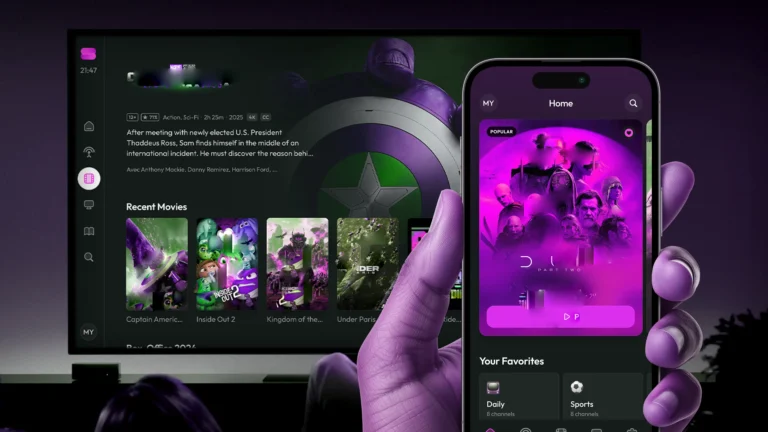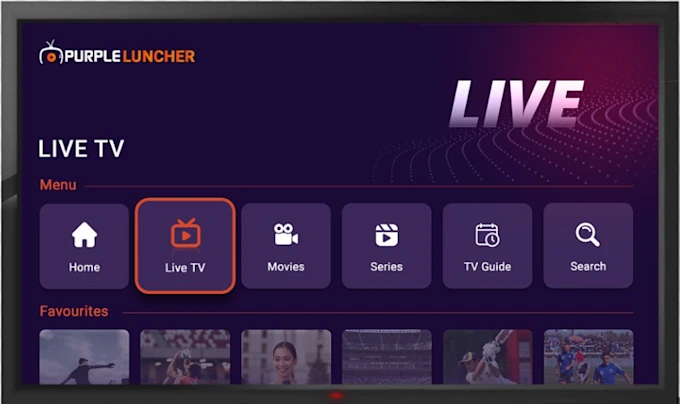



Smart IPTV in 2026 is best understood as a delivery system that runs over IP networks and plays video on modern devices (especially Android TV boxes, Smart TVs, phones, tablets, and PCs). When people say “smart,” they usually mean the experience feels consistent: it starts quickly, stays stable during evenings, and behaves the same across devices. That consistency does not come from marketing. It comes from how the service is operated: infrastructure capacity, distribution logic, monitoring, uptime discipline, and multi-device readiness.
This Part 1 is written to be professional and DMCA-safe. It focuses on reliability and operations, not on listing content or describing “access.”
What smart IPTV means in 2026 (simple definition)
Smart IPTV is a network-delivered TV/video experience that uses IP delivery rather than traditional broadcast signals, and it is consumed through a “smart” device environment (Android TV box, Smart TV, mobile, PC). In practical terms, smart IPTV is not one single thing you “install.” It is a combination of the service platform (accounts, servers, distribution) and the device environment (how your box or TV handles playback, networking, and long sessions). When those two layers work well together, the experience feels stable. When either layer is weak, the experience becomes inconsistent, especially during peak hours.
A useful mindset is to treat smart IPTV like any online service you rely on daily. You are not only buying “availability.” You are buying predictability. Predictability is what makes users trust a service over months, not just during a quick test on an easy day.
Quote (2026 reliability mindset):
“If it only works on the easiest day, it isn’t reliable — it’s lucky.”
What people really want when searching “smart IPTV”
Most readers are not trying to become network engineers. They are trying to avoid frustration. The typical search intent behind smart IPTV is a mix of:
- “I want it to work smoothly on my main screen.”
- “I want stable performance during evenings and weekends.”
- “I want it to run on multiple devices without constant troubleshooting.”
- “I want clear plans, clear support, and clear expectations.”
Some people widen the search into provider comparisons like best iptv service providers or location-based terms like iptv service providers in usa because they are trying to reduce risk and find stability signals. The professional way to answer that intent is not with rankings, but with a clear evaluation model that works worldwide.
This is also where worldiptv can be positioned cleanly: as a structured reference path (plans + guidance + stability resources) rather than a hype-heavy sales pitch.
Smart IPTV without confusion (terms people mix up)
A lot of “smart IPTV” content online becomes confusing because it mixes device terms, service terms, and marketing terms. Keeping the language clean makes the page easier to trust and easier to use.
Clarity table: what each term usually means
| Term people use | What it usually refers to | What matters most in 2026 |
|---|---|---|
| smart IPTV | stable IPTV experience on modern devices | predictability across peak hours |
| IPTV box | the playback device (often Android TV) | networking + long-session stability |
| service provider | the platform running delivery + accounts | monitoring + capacity + support |
| stability | consistent playback under real conditions | peak-hour variance + recovery behavior |
| multi-device | same account used across environments | device consistency + session handling |
The reliability model (how professionals judge smart IPTV quality)
A smart IPTV experience is “good” when it behaves consistently under normal life conditions. The easiest mistake is to judge quality from a short test during off-peak hours. A professional evaluation looks at signals that predict long-term satisfaction, not short-term luck. These signals are simple enough for any reader to understand:
- Start success rate: does playback start normally on the first attempt?
- Peak-hour variance: does performance drop noticeably at night or on weekends?
- Buffering frequency: how often does playback pause?
- Recovery behavior: if the network dips briefly, does playback recover quickly?
- Device consistency: does Android TV behave similarly to mobile or PC?
These signals matter because they map to the real reasons people abandon services: repeated retries, evening instability, and “works on one device but not another” confusion. A mature service reduces these problems by design, using capacity planning, distribution logic, and monitoring discipline.
Smart IPTV reliability scorecard (copy/paste table)
| Signal | What it means | What “good” looks like in 2026 |
|---|---|---|
| Start success | session begins reliably | starts first try most of the time |
| Peak-hour variance | stability under load | evenings remain consistent |
| Buffering rate | delivery stability | buffering is rare and brief |
| Recovery behavior | resilience | quick recovery after small dips |
| Device consistency | multi-device readiness | similar behavior across devices |
Why device environment matters (and why “good IPTV boxes” are part of smart IPTV)
The phrase “smart IPTV” often hides the biggest variable: the device environment. Two people can use the same service and report different experiences because one device is stable for long sessions and the other struggles under load. A good IPTV box in 2026 doesn’t “create” quality on its own. It reduces instability by providing a consistent environment: steady networking, reliable long-session performance, and predictable software behavior.
In practice, this is why many households prefer Android TV devices for their main screen. Android TV boxes are easier to standardize and test compared to many built-in TV environments, which can vary widely across models. Standardization matters because it helps you evaluate the service fairly. When the device is unstable, users often blame the provider even when the root cause is local.
IPTV box stability checklist (2026)
| Criteria | What to look for | Why it improves stability |
|---|---|---|
| Network options | Ethernet + strong Wi-Fi | fewer local dropouts |
| Performance | enough CPU/RAM for long sessions | fewer freezes and slowdowns |
| Heat stability | runs cool under load | avoids performance drops |
| OS consistency | stable updates | fewer random compatibility issues |
| Storage headroom | adequate free space | better long-term performance |
Mini case study: why one setup feels “perfect” and another fails
Two households subscribe to a similar smart IPTV service. Household A uses an Android TV box connected on a stable network setup and tests one evening session before committing. Their experience is consistent: playback starts normally, buffering is rare, and the device remains responsive during long sessions. Household B relies on an older built-in TV environment over weak Wi-Fi. Their first test looks fine, but weekend evenings show slow starts and occasional buffering. They assume the service is unreliable, but the pattern suggests a combination of peak-hour stress plus a weaker device/network environment.
The outcome is not “one household is right and the other is wrong.” The outcome is that smart IPTV reliability is a system: provider operations matter, but device and network environment can heavily shape what users feel. The professional way to reduce risk is to standardize the main device and run a peak-hour validation before choosing a long plan.
Quote (practical decision rule):
“Commit long-term only after you’ve seen stable evenings.”
Distribution table (plain-language)

| Delivery pattern | What it means | What it improves | What it does not guarantee |
|---|---|---|---|
| Single-region delivery | most sessions route through one hub | simplicity | stable performance worldwide |
| Multi-region delivery | sessions are balanced across regions | better peak-hour consistency | perfect results on every ISP |
| CDN-style delivery | delivery closer to users | faster starts, fewer spikes | flawless Wi-Fi at home |
Scalability and uptime discipline: the enterprise mindset behind smart IPTV
A stable smart IPTV platform behaves like a managed service. That means it is designed to grow without breaking. Scalability is not a buzzword; it’s the difference between a system that stays consistent as demand grows and a system that becomes unstable as it gets popular. The most common long-term failure pattern is simple: a service launches, users love it, adoption increases, and performance drops because capacity and distribution were not expanded in time. A mature provider prevents this by planning growth, expanding resources before the platform becomes stressed, and monitoring quality signals that show early warning signs.
Uptime discipline also means the platform is designed for failure. Networks fail. Nodes fail. Routes change. The professional difference is what happens when something breaks. A platform with resilience can shift traffic and recover quickly. A fragile platform produces long downtime events and confusing, inconsistent behavior that spreads across devices.
Redundancy: the safety net users don’t see
Redundancy is how services avoid “everything is down” moments. A redundant system has alternative paths and backups so a single component failure doesn’t take down the whole experience. This is one of the strongest trust signals because it reflects how the service is engineered. It also reduces support chaos. When a platform fails without redundancy, support is overwhelmed and users receive generic responses. When redundancy exists, incidents are smaller and recovery is faster, which keeps user trust stable.
Scalability and resilience table
| Operational area | What mature platforms do | What users notice |
|---|---|---|
| Scalability | add capacity before peak stress | fewer evening performance drops |
| Uptime discipline | plan for incidents and recovery | fewer long outages |
| Redundancy | backups and failover paths | faster stabilization |
| Consistent operations | repeatable processes | fewer recurring issues |
Monitoring: measuring what users actually feel (not just “uptime”)
Monitoring is the clearest sign that smart IPTV is being run professionally. Uptime alone can be misleading because a system can be “up” while users still face failed starts or frequent buffering. Professional monitoring focuses on experience signals: does playback start reliably, how does buffering change at peak hours, how quickly does the platform recover after stress, and do certain device environments fail more often than others. These signals translate directly into what users perceive as reliability.
Monitoring also prevents repeated frustration. If a platform tracks start failure rates and sees them rising during evenings, the platform can act before users flood support. If the platform tracks device-specific error patterns, it can publish clearer guidance for Android TV environments and reduce false blame on the service itself. Monitoring is therefore both a technical practice and a trust practice: it reduces recurring issues and increases transparency in how problems are handled.
Monitoring signals table
| Signal | What it means | Why it matters |
|---|---|---|
| Start success rate | sessions begin reliably | fewer retries and complaints |
| Buffering frequency | stability under load | smoother long sessions |
| Peak-hour variance | consistency at busy times | predictable evenings/weekends |
| Device error patterns | device-specific instability | fewer “works here, fails there” cases |
| Recovery time | resilience after incidents | faster return to normal |
Multi-device environments: why smart IPTV must behave consistently across devices
Smart IPTV is not “one device.” Most homes use a main screen plus secondary devices. That means the platform is judged on consistency: Android TV behavior compared to mobile, PC, and Smart TV environments. Device differences are normal. The problem is when the service becomes unpredictable across them. Unpredictability often comes from a combination of platform stress and device environment limits. For example, Android TV boxes can be stable for long sessions, but they can also reveal instability more clearly because they stay running for long periods and depend on consistent decoding and network conditions.
A professional approach to multi-device environments is to validate on the primary device first, then confirm on one secondary device. If the service works on one device and not another, that is a diagnostic signal. It usually means you are dealing with a device session, device performance, or local network issue—not a complete renewal failure or a total platform failure.
Multi-device validation table (simple)
| Device type | Best first test | What it tells you |
|---|---|---|
| Android TV box | 30–60 minute session | true long-session stability |
| Phone/tablet | quick confirmation test | account/session recognition |
| PC | short playback session | environment consistency |
| Smart TV | peak-hour test | device variability under load |
Practical stability map: symptoms → likely layer → first check
This table is designed to be copied into your page and used as the “most helpful” section for readers who want clarity without technical overload.
| Symptom | Likely layer | Best first check |
|---|---|---|
| Starts slow only at night | peak-hour congestion/load | run a peak-hour validation session |
| Buffering spikes in bursts | delivery variance | compare Ethernet vs Wi-Fi if possible |
| Works on phone, not Android TV | device session/environment | restart and re-login on Android TV |
| Random stops after 30–60 min | device performance/heat | long-session test + ensure stable device setup |
| Works off-peak, fails weekends | capacity stress | validate before long plan commitment |
Where to go next inside worldiptv (structured path)
A professional smart IPTV experience is built through a simple flow: learn how stability works, choose a plan duration that matches certainty, then validate in your device environment before committing long-term. These internal pages can be placed naturally after this infrastructure section as the next step for readers who want structure:
Use Cases: Smart IPTV for Home, Power Users, Business, and Hospitality
Smart IPTV is more than just a service—it’s a system designed to work for various types of users. Depending on whether you’re a home user, a power user with multiple devices, a business needing reliable in-house streaming, or a hospitality provider offering IPTV to guests, the use case can vary greatly. What remains constant, however, is the need for stability, predictability, and ease of management.
In this section, we’ll walk through each use case and provide clear, practical advice on how to ensure your smart IPTV service performs consistently across different environments.
Home Use Case: Simple, Stable Streaming for Family and Personal Use
For many people, smart IPTV is simply about cutting the cord from traditional cable and enjoying flexible, high-quality TV. In home environments, the goal is usually to reduce complexity—streaming should work with minimal intervention, ideally offering smooth starts, fewer buffering issues, and compatibility with the devices they already own.
Key Considerations:
- Device setup: Most homes have one or two main devices for streaming (Android TV, Smart TV, or mobile).
- Device consistency: Home users often start with Android TV or Smart TVs connected to their main screen. It’s essential to standardize these devices to ensure a smooth viewing experience.
- Network stability: Home networks can vary significantly in quality—Wi-Fi issues can lead to buffering, especially during peak hours (evenings and weekends).
- Plan choice: Home users are often best served by shorter plans initially (1–3 months) to validate stability.
Home User Checklist
| Criteria | What to do | Why it matters |
|---|---|---|
| Device setup | Start with Android TV or Smart TV | Reduces initial complexity |
| Network check | Test with a stable Wi-Fi/ethernet connection | Ensures stable playback |
| Session length | Test 30-60 minute session | Verify long-session performance |
| Peak hours test | Validate during evenings | Confirm reliability at busy times |
| Plan selection | Try 1–3 months first | Minimize risk before longer commitment |
Case Insight:
Sarah from London signed up for worldiptv.store’s Standard 12-month plan after testing the service for one month. She found the Android TV setup smooth, with consistent streaming in Full HD. The peak-hour validation confirmed reliable performance, giving her confidence in her long-term decision.
Power Users: Multi-Device Streaming + Peak-Hour Performance
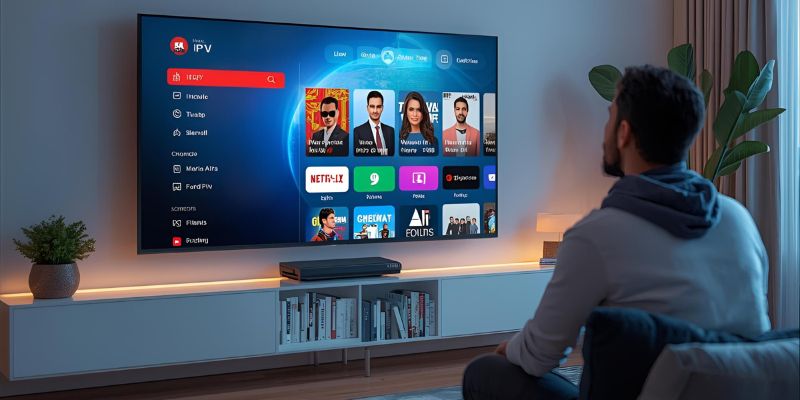
Power users typically require flexibility, allowing them to watch on multiple devices simultaneously or at different times of the day. This might include streaming on Android TV while using a mobile device for secondary viewing, or enjoying PC streaming on larger monitors. Power users also tend to have higher expectations for performance, particularly under load.
Key Considerations:
- Multiple device usage: Power users expect their IPTV to function seamlessly across devices. This might include phones, tablets, PCs, Android TV, and Smart TVs.
- Peak-hour demand: Power users are typically active during high-traffic times (evenings), which can stress the network.
- Stability validation: The key challenge is keeping performance stable during heavy usage. Power users should validate their service by testing during peak hours.
- Plan choice: Power users should test short-term plans (1–3 months) first to confirm scalability and ensure consistent device behavior.
Power User Checklist
| Criteria | What to do | Why it matters |
|---|---|---|
| Device variety | Test across 2-3 devices | Validate multi-device support |
| Network bandwidth | Use Ethernet or strong Wi-Fi | Reduces the risk of performance dips |
| Peak-hour test | Run tests in the evening | Confirm stability during busy hours |
| Session length | Run longer tests (60+ minutes) | Simulate real-world use conditions |
| Plan selection | Test with 1–3 month plans first | Validate stability before commitment |
Case Insight:
Mark, a tech enthusiast from New York, subscribes to the Premium 24-month plan after he confirmed that worldiptv.store’s service provided consistent performance across multiple devices. After running several evening tests, he was impressed by the stability during prime-time hours.
Business Use Case: Reliable In-House Streaming for Employees
For businesses, smart IPTV is no longer just about television; it’s about delivering reliable entertainment and informational content to employees, customers, or clients. Whether it’s used for training, waiting areas, or employee break rooms, businesses require consistent quality and performance to maintain professionalism.
Key Considerations:
- Scalability: Businesses often need the capability to scale easily, whether it’s adding more devices or offering additional services without downtime.
- Centralized control: Business-grade systems often benefit from centralized control of subscriptions and devices.
- Reliability: Businesses cannot afford to have intermittent service interruptions. Consistent uptime is a priority.
- Plan choice: Business users might consider annual plans for long-term stability and cost-effectiveness.
Business User Checklist
| Criteria | What to do | Why it matters |
|---|---|---|
| Scalability | Check plan limits (devices/users) | Ensure flexibility for expansion |
| Device setup | Standardize with Android TV | Simplifies management |
| Network setup | Ensure stable business-grade network | Prevents interruptions |
| Peak-hour test | Test performance during office hours | Ensure reliability at all times |
| Plan selection | Choose 12+ months for simplicity | Reduce administrative workload |
Case Insight:
A co-working space in Berlin chose the Standard 12-month plan to provide IPTV content to clients across 20+ Android TVs. The service’s reliable performance throughout the day, even during peak hours, led to a long-term commitment.
Hospitality Use Case: Scalable IPTV Solutions for Hotels and Resorts
In the hospitality industry, IPTV services are often offered to guests, delivering entertainment directly to their rooms or common areas. With multiple devices, rooms, and varying guest needs, consistency and scalability are essential to a professional hospitality IPTV system.
Key Considerations:
- Scalability: As the number of rooms and devices increase, the IPTV solution must scale seamlessly without compromising quality.
- Guest experience: A smooth, reliable IPTV system enhances the guest experience and can be a differentiator for hotels.
- Device support: The system must work well across different devices—Smart TVs, Android TV, and mobile devices.
- Plan choice: Typically, hospitality businesses will prefer annual plans due to the consistent need for service across the year.
Hospitality User Checklist
| Criteria | What to do | Why it matters |
|---|---|---|
| Scalability | Ensure service supports multiple rooms | Prevents service drops during peak periods |
| Device standardization | Use Android TV boxes where possible | Simplifies troubleshooting and maintenance |
| Network setup | Use business-grade network for rooms | Prevents Wi-Fi congestion issues |
| Customer experience | Test at different times of day | Ensure service is stable during guest check-in/check-out |
| Plan selection | Opt for 12+ months for cost-effectiveness | Streamlines budget and planning |
Case Insight:
A luxury hotel in Dubai implemented smart IPTV in over 100 rooms. After testing the service with a Standard 12-month plan, the hotel found that guests enjoyed a smooth viewing experience, with 24/7 support ensuring that any issues were dealt with quickly and professionally.
A Practical Validation Log: Testing Stability in Real-World Environments
For any user—home, power user, business, or hospitality—the best way to validate a smart IPTV service is by testing it during real conditions. This includes testing during peak hours, across multiple devices, and over longer sessions. Here’s a 7-day validation log example to help track the quality of service over time.
| Day | Device tested | Time tested | Start success | Buffering notes | Result |
|---|---|---|---|---|---|
| 1 | Android TV | off-peak | Yes | None | Stable |
| 2 | Phone | peak-hour | Yes | Medium | Needs review |
| 3 | Smart TV | off-peak | Yes | Low | Stable |
| 4 | Android TV | peak-hour | Yes | High | Needs review |
| 5 | PC | off-peak | Yes | None | Stable |
| 6 | Android TV | peak-hour | No | High | Unstable |
| 7 | Phone | peak-hour | Yes | Low | Stable |
By validating this way, you gain better insight into how smart IPTV behaves in different contexts, which is essential for making an informed decision before committing to a long-term plan.
Where worldiptv fits in this workflow
For users looking for a structured IPTV solution, worldiptv.store offers clear paths to follow based on your use case. Whether you’re an individual looking for stable home entertainment or a business seeking consistent IPTV services, we have flexible plans and support options that fit a wide range of needs. Explore more about our offerings:
- Learn more about our plans: worldiptv.store/world-iptv-plans
- Check out our device guides and recommendations: worldiptv.store/iptv-store-guide
- Stay informed with our blog updates: worldiptv.store/worldwide-iptv-blogs
- Browse our 24/7 support options: worldiptv.store
External references (links only)
For further context and insights on the IPTV market and technical backgrounds:
- Verified Market Research on 4K set-top boxes
- IEEE on IPTV over IP
- Fortune Business Insights on IPTV market
Conclusion
Smart IPTV in 2026 is all about stable, high-quality, and reliable streaming experiences. Whether you are a home user, a power user, a business, or a hospitality provider, your experience depends heavily on how well the infrastructure is managed and how consistently the service behaves across devices and peak hours. By understanding the importance of device stability, network consistency, and monitoring, you can choose the right provider and ensure a long-term, smooth viewing experience.
If you’re ready to get started, explore our plans and see why worldiptv.store is the smart choice for the next level of IPTV.
Deep FAQ: Everything You Need to Know About Smart IPTV

As smart IPTV becomes more popular in 2026, there are many questions people have before committing to a service. From understanding how to choose the right provider to troubleshooting common issues, a comprehensive FAQ section is crucial to answer those concerns. Below are some of the most common questions and answers to guide you through your smart IPTV journey.
What does smart IPTV mean in 2026?
Smart IPTV refers to internet-based television delivery, where content is streamed to devices (such as Android TV, Smart TVs, and mobile devices) using an internet connection instead of traditional broadcast methods like cable or satellite. The focus of smart IPTV in 2026 is reliability, multi-device compatibility, and scalability to meet modern users’ needs.
How does smart IPTV differ from traditional cable or satellite TV?
Unlike traditional cable or satellite TV, smart IPTV uses your internet connection to stream content. This allows you to watch a wide variety of channels and on-demand video without the need for a satellite dish or cable box. Additionally, smart IPTV offers better flexibility, more content options, and affordable pricing compared to cable or satellite packages.
Is smart IPTV available worldwide?
Yes, smart IPTV services are available in most countries across the world. However, the quality of service may vary depending on local infrastructure, such as broadband speed and device compatibility. Always verify the service’s performance in your area, especially during peak hours, to ensure stability.
What is the best device to use for smart IPTV?
The best device for smart IPTV depends on your needs, but Android TV devices are often the most consistent, offering great performance, stability, and easy setup. Other devices such as Smart TVs, set-top boxes, and mobile phones are also compatible, but Android TV devices tend to provide the best experience for long-term use.
How can I ensure the best performance with smart IPTV?
To ensure the best performance:
Use a wired Ethernet connection whenever possible (Wi-Fi can cause instability, especially at peak hours).
Ensure that your internet speed is at least 20 Mbps for HD content and 25 Mbps or higher for 4K.
Restart devices regularly and ensure they are using the latest software updates.
Test at peak hours to ensure the service handles busy times, like evenings or weekends.
Clear the app cache on devices periodically to maintain smooth streaming.
How do I choose the right smart IPTV plan?
Choosing the right smart IPTV plan depends on your usage habits. If you are new to IPTV, it’s recommended to start with a short-term plan (e.g., 1–3 months) to test the service. Once you’re confident in the provider’s stability and performance, you can opt for longer plans (e.g., 12–24 months) for convenience and cost savings.
Plan choices:
1 month: Ideal for new users to test stability.
3 months: Best for typical households that need moderate usage.
12–24 months: For long-term users who want consistency and the best value.
What support does worldiptv.store offer for smart IPTV?
At worldiptv.store, we provide comprehensive support to ensure a smooth experience:
24/7 live chat and email support to assist with setup, troubleshooting, and general queries.
Setup guides to help you configure your devices and get started quickly.
Detailed FAQs to troubleshoot common issues and enhance your experience.
Visit worldiptv.store for direct support, or explore our help center for detailed setup instructions.
DMCA-safe legal clarity (must-have)
At worldiptv.store, we provide legal clarity around IPTV services:
- IPTV is a delivery technology, not a way to “unlock” content.
- This guide focuses on stability, device support, and service operations, not accessing illegal streams.
- Users are responsible for complying with local laws regarding IPTV usage and content viewing.
- We do not endorse or promote illegal streaming, bypassing, or using unlicensed content.
By focusing on legitimate service operations, we ensure that users enjoy stable, professional IPTV solutions without violating any laws.
Final Thoughts
Smart IPTV is the future of television viewing, offering flexibility, affordability, and the power to cut the cord without sacrificing quality. Whether you are a home user, a power user, a business, or a hospitality provider, smart IPTV in 2026 ensures you can enjoy TV on your own terms, with minimal interruptions and maximum control. By focusing on reliable infrastructure, device consistency, and professional service operations, smart IPTV provides the best possible experience.
Ready to make the switch? Visit worldiptv.store to explore our plans and get started today!