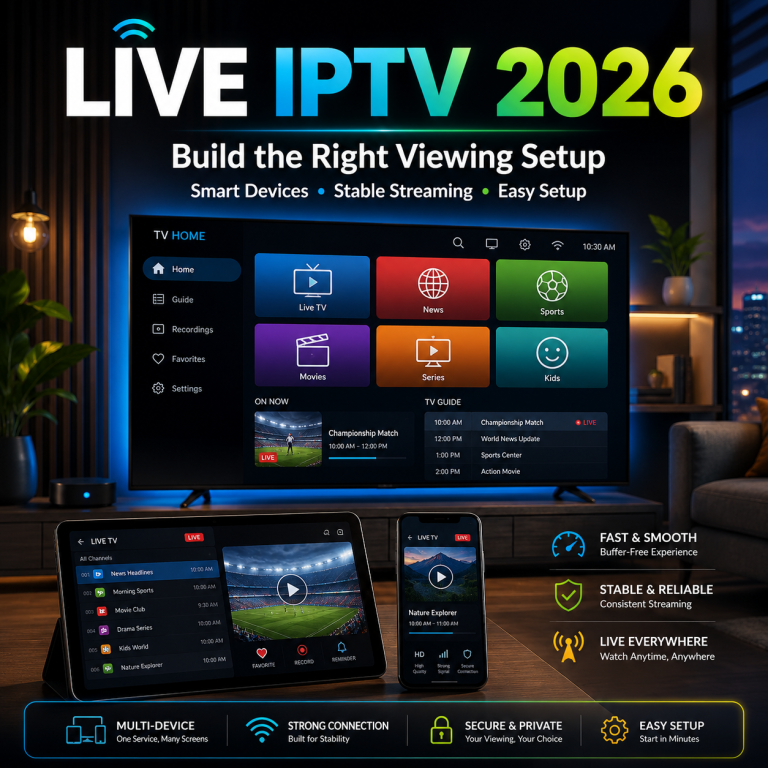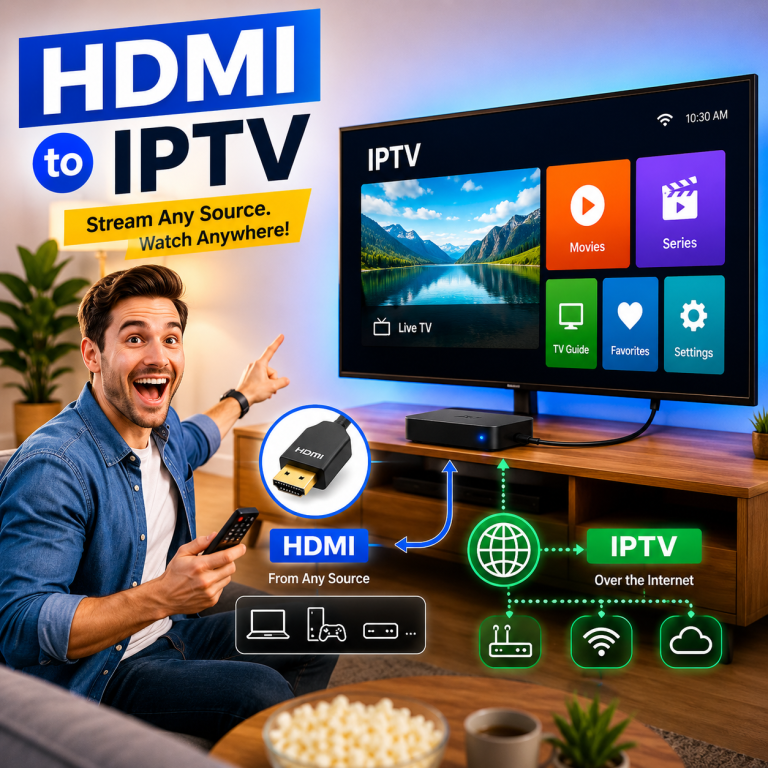



An iptv stream is a video stream delivered over IP networks (internet-based delivery) rather than traditional broadcast signals. In 2026, the difference between a smooth experience and a frustrating one usually comes down to reliability: how consistently the stream arrives, how calmly your player handles variation, and how professionally the service behind the stream is operated. This Part 1 gives you clear definitions, a practical stability framework, and a simple end-to-end model you can use to evaluate an IPTV stream across all devices—from Android TV to smart TVs, mobile, and desktop—without risky or low-trust wording.
“Stability is not a feature. It’s a system outcome.”
Table of Contents
Quick answer: What is an IPTV stream?
An iptv stream is a playback session where your device requests video segments (or a continuous stream) over the internet, decodes them, and presents them on screen. The important part is that the stream is not “one thing”—it’s a chain of moving parts. Even if your internet plan looks strong, the stream can still feel unstable if the network is inconsistent, the device struggles to decode smoothly, or the service behind the stream is not operated with mature monitoring and capacity planning.
In practice, a stable IPTV stream in 2026 is built on three foundations:
- Player/device stability (can your device decode smoothly for long sessions?)
- Network consistency (does delivery arrive steadily during peak times?)
- Service operations maturity (monitoring, redundancy, controlled changes, support discipline)
If you want a neutral, professional foundation before you evaluate any plan or service, these internal guides are good context:
- https://worldiptv.store/iptv-store-guide/
- https://worldiptv.store/category/iptv-world-tv/
- https://worldiptv.store
What people mean when they search “iptv stream” in 2026
Most users searching iptv stream want one of these outcomes:
- Understanding: “What is an IPTV stream, technically?”
- Reliability help: “Why does my stream stall or drop quality?”
- Evaluation: “How do I choose a service that stays stable long-term?”
- Device fit: “Will it work on Android TV, smart TV, mobile, and desktop?”
The problem is that the IPTV topic online often gets mixed with low-trust language. That’s why a high-trust article should avoid “catalog promises” and focus instead on performance, stability, monitoring, and uptime discipline. This approach also reduces the risk of your page being clustered with thin or risky content and helps indexing because it provides real user value.
Intent map (so the article stays clean and useful)
| Intent | What the reader wants | What we deliver in this guide |
|---|---|---|
| Transactional (trust) | confidence before committing | stability framework + trust signals |
| Informational | clear definition + system model | end-to-end explanation |
| Commercial (soft) | plan evaluation without pressure | “evaluate → validate → commit” logic (later parts) |
DMCA-safe boundary and legal clarity (short)
IPTV is a delivery technology for video over IP networks. Legality depends on licensing and jurisdiction. This guide focuses on technology, stability, and service operations. It does not provide bypass instructions or guidance for accessing unlicensed content. Users are responsible for lawful use.
How an IPTV stream works: the end-to-end delivery model
A reliable IPTV stream is best understood as a delivery pipeline. If you only look at the app, you miss half the system. If you only look at “internet speed,” you miss why stability varies from one hour to the next. The clearest model is a chain:
Device/App → Home Network → ISP Path → Service Delivery (servers/CDN/ops)
Each stage can introduce instability, and each stage leaves different patterns you can observe—without needing complicated tools.
Delivery chain map (where issues typically originate)
| Segment | What can go wrong | What you notice | What it suggests |
|---|---|---|---|
| Device/App | decoding or player instability | freezes, audio drift, UI lag | device/app limitation |
| Home network | Wi-Fi noise, congestion, router overload | evening stalls, room-specific issues | local consistency problem |
| ISP path | routing/peak contention | time-of-day variability | upstream variability |
| Service delivery | capacity planning + ops maturity | repeated outages, long recovery | service-side maturity issue |
A key insight: a good device can smooth small bumps, and a good service can reduce delivery volatility—but neither can fully compensate if another segment is consistently weak.
The 3-pillar stability framework (simple and repeatable)
If you want one method that keeps you out of guesswork, use the 3-pillar framework. It’s designed to be non-templated (meaning you can apply it uniquely in many posts) and it naturally supports a professional, DMCA-safe tone.
Pillar 1: Player and device stability
A stable IPTV stream requires decoding that stays smooth for long sessions. Some devices handle long playback better than others, and some apps handle memory and playback pipelines more cleanly. When the player is stable, the stream feels calm: navigation stays responsive, playback controls behave predictably, and long sessions don’t “degrade” over time.
Practical signs of strong player stability
- controls remain responsive after long viewing
- the UI doesn’t slow down under normal use
- audio stays aligned with video in longer sessions
Pillar 2: Network consistency
Streaming doesn’t just need “enough bandwidth.” It needs steady delivery. In real homes, stability changes based on time of day, number of connected devices, and Wi-Fi conditions. That’s why reliability testing should mirror real usage: the same room, the same hours, and the same household load.
Practical signs of strong network consistency
- fewer abrupt stalls during peak household usage
- quality changes are smooth rather than constant up/down movement
- the experience is similar across devices on the same network
Pillar 3: Service operations maturity
This is the part most content ignores—and the part that matters most for long-term trust. Professional services behave like systems that are monitored and maintained: they plan capacity, manage changes carefully, and support users with structured diagnostics.
Practical signs of mature operations
- clear communication when issues occur
- predictable maintenance behavior (not random disruptions)
- support that asks meaningful environment questions (device, timing, reproducibility)
IPTV stream stability score table (quick evaluation)
| Pillar | What users feel | What to validate | Trust signal |
|---|---|---|---|
| Device/player | UI lag, freezes, drift | long-session behavior | maintained apps + stable platform |
| Network | stalls at busy times | time-based comparison | consistent home setup |
| Service ops | repeated outages | transparency + support | monitoring + disciplined changes |
For evaluation mindset and plan structure (without pressure), this internal reference is useful later:
https://worldiptv.store/world-iptv-plans/
Mini case study: why the same IPTV stream feels different on two devices

Scenario: A household uses the same internet connection and tests the same IPTV stream on two devices: one Android TV setup in the living room and a mobile device on the same Wi-Fi.
Observation: The mobile device feels “fine,” while the living-room experience feels more sensitive: occasional UI lag, playback stutters during busy evening hours, and slower recovery after a brief stall.
What this usually means (professional interpretation): The larger-screen living-room workflow is less forgiving because sessions are longer and interaction expectations are higher. Small delivery inconsistencies that a phone “hides” can feel bigger on a TV. This is not a reason to blame a single component; it’s a reminder that a stable IPTV stream is the result of the entire chain behaving well. When you evaluate reliability, you should test in the environment that matters most—your normal time window and your primary viewing device.
“A good test is not a quick demo. A good test is your real evening usage.”
Pillar pages on worldiptv.store (recommended reading)
To keep your content architecture strong and avoid thin internal linking, use a calm “read next” paragraph that matches the topic (reliability and evaluation), rather than repeating the same link block everywhere:
- https://worldiptv.store/iptv-store-guide/
- https://worldiptv.store/world-iptv-plans/
- https://worldiptv.store/category/iptv-world-tv/
- https://worldiptv.store/iptv-germany-2025/
- https://worldiptv.store
Industry context (external sources, links only)
These sources are useful for calm market context and the broader OTT/video environment, without drifting into risky content framing:
https://www.fortunebusinessinsights.com/internet-protocol-television-iptv-market-106645
https://www.grandviewresearch.com/industry-analysis/internet-protocol-television-iptv-market
https://de.statista.com/outlook/amo/medien/tv-video/ott-video/weltweit
Delivery architecture in 2026: what keeps an IPTV stream stable under real traffic
A stable iptv stream is usually the result of distribution + discipline. Distribution means the delivery is not concentrated in one place; discipline means changes, capacity, and incident response are handled in a predictable way. In 2026, the “best-looking” interface is less important than whether the stream stays calm when conditions change (peak hours, busy households, or shifting network routes). That calmness comes from an end-to-end design where each layer does its job: the player decodes smoothly, the network stays consistent, and the service delivery layer keeps throughput steady.
“Reliability is what happens when capacity planning meets operational discipline.”
Server & CDN logic in 2026: what “good delivery” technically means
Modern delivery systems typically use a layered approach: an origin (where the stream is prepared), a distribution layer (regional/edge delivery), and the last mile (your ISP and home network). The practical reason is simple: shorter and better-balanced delivery paths reduce volatility. When demand spikes, distributed delivery helps avoid overload cascades, where a single saturated point drags down many viewers at once. For you, that means fewer “sudden stalls,” fewer “micro-freezes,” and less quality “yo-yo” behavior during busy times.
Delivery quality checklist (user-visible signals)
| What you can notice | What it often indicates | Why it matters to an IPTV stream |
|---|---|---|
| Stable playback at peak hours | delivery has headroom | less saturation risk |
| Short, rare interruptions | small route variance | buffer recovers quickly |
| Fast recovery after a dip | resilient distribution | better continuity |
| Consistent behavior across devices | stable delivery layer | fewer random errors |
CDN & scalability evaluation table (non-technical, but accurate)
| Area | Strong sign | Weak sign | Reliability impact |
|---|---|---|---|
| Distribution | regional/edge delivery | single-region delivery | peak stability |
| Capacity | planned headroom | frequent saturation | fewer stalls |
| Redundancy | continuity mindset | unclear approach | fewer repeated outages |
| Change control | controlled rollouts | surprise changes | fewer regressions |
| Transparency | clear service updates | silence | faster diagnosis |
Adaptive streaming (ABR): why quality changes are not automatically “a problem”
In 2026, many delivery pipelines use adaptive behavior: the player chooses a quality level that fits current conditions so playback can continue. This is a normal stability strategy. What separates a mature experience from a weak one is the style of adaptation:
- Mature behavior: fewer switches, smoother transitions, quicker recovery
- Weak behavior: constant up/down quality bouncing, frequent pauses, confusing states
“Calm adaptation” indicators (what good looks like)
| Indicator | What it means | Why users care |
|---|---|---|
| Fewer quality switches | steady throughput | less visual distraction |
| No long pauses | buffer stays healthy | smoother viewing |
| UI stays responsive | player not overloaded | better control and navigation |
| Quick recovery | delivery is resilient | less frustration |
IPTV stream diagnostics: a reliability-first map (not generic troubleshooting)
Instead of blaming one thing (“the app” or “the internet”), use a pattern-based check. This helps you separate device/player limits from network consistency and service delivery maturity—without any risky instructions.
Symptom pattern → likely layer → what to compare
| Symptom pattern | Most likely layer | What to compare (principle) |
|---|---|---|
| Works mornings, degrades evenings | network/service load | time-of-day stability |
| One device struggles, others fine | device/player | same time, different device |
| All devices degrade together | home network / ISP path | cross-device correlation |
| Repeated outages across days | service operations | transparency + support response |
| Audio/video drift after long play | player pipeline | long-session behavior |
Root-cause clustering (so the post stays unique)
| Cluster | Typical trigger | What it looks like | Best next validation (non-instructional) |
|---|---|---|---|
| Peak contention | evening/weekend demand | recurring dips at similar times | compare peak vs off-peak |
| Home network variance | interference/overload | room-specific instability | compare locations |
| Player stress | long sessions | UI lag, drift, freezes | test long viewing session |
| Ops maturity gap | weak monitoring/change control | repeating incidents | evaluate support + clarity |
Monitoring & uptime discipline: how professional services reduce repeat failures
If you want an IPTV stream that holds up long-term, look for signs of operational maturity. In mature systems, monitoring is not “nice to have”—it’s the mechanism that prevents the same outage from repeating every week. You’ll notice it indirectly: issues get acknowledged faster, recurring faults get fixed, changes feel controlled, and support asks structured questions instead of guessing.
What monitoring means for you (user outcomes)
- Faster detection: problems are seen early, not only after many complaints
- Fewer repeats: recurring issues are treated as root-cause work, not “temporary resets”
- Safer changes: updates happen with discipline, reducing surprise breakage
- Better support: environment-based diagnosis (device, timing, reproducibility)
Ops maturity scorecard (0–2 per category)
| Category | 0 | 1 | 2 |
|---|---|---|---|
| Incident communication | unclear | reactive | proactive & clear |
| Change discipline | chaotic | mixed | controlled & documented |
| Monitoring posture | not visible | basic | mature & consistent |
| Support quality | generic | ok | diagnostic & helpful |
| Transparency | low | medium | clear & verifiable |
How to read it:
- 0–4: high risk of repeating problems
- 5–7: usable, but not operations-grade
- 8–10: mature reliability (better long-term stability)
Mini case study (Part 2): a small business “lobby TV” scenario
A small office uses Android TV in a waiting area. The IPTV stream plays fine most days, but when the office network is busy (calls, uploads, visitors on Wi-Fi), playback becomes inconsistent. The key insight is that “business reliability” is less about features and more about predictability: a mature service setup tends to recover faster and fail less often because capacity planning and monitoring reduce repeat incidents. In these environments, the right decision is usually the one that minimizes repeat disruption, even if it looks less flashy on paper.
“Business-grade quality is: fewer incidents, faster recovery, clearer support.”
External context (long paragraphs, links only)
Market research helps explain why IPTV stream reliability matters more each year: as IPTV grows and more viewing shifts to IP-based delivery, user expectations move toward consistent uptime and stable performance rather than novelty. That broader market context is covered here: https://www.fortunebusinessinsights.com/internet-protocol-television-iptv-market-106645
A second industry view reinforces the same direction—growth increases pressure on delivery infrastructure, peak-hour behavior, and operational discipline, which is why monitoring, distribution and scalability are central to long-term stability: https://www.grandviewresearch.com/industry-analysis/internet-protocol-television-iptv-market
For the wider OTT/video ecosystem context, this outlook page is useful for framing how IP-delivered video fits into global media consumption patterns: https://de.statista.com/outlook/amo/medien/tv-video/ott-video/weltweit
Use cases 2026: how to choose an IPTV stream that fits your environment
Choosing an iptv stream is not only about “does it play right now.” In 2026, the best results come from matching the stream to your environment: how many devices share the network, how long sessions run, and how much stability you need when conditions change. A single-person household can tolerate occasional dips more easily than a family living room setup, and both are very different from a business lobby screen or a hospitality multi-room environment. This section keeps it practical: you’ll see what matters for each use case, which trust signals predict long-term stability, and how to avoid setups that look fine in a quick demo but fail under real traffic.
“The right IPTV stream is the one that stays consistent in your peak hours.”
Home power users: multi-device households and peak-hour stability
For home power users, the most common stability pressure is simply competition: several devices using the same network at the same time. Even when you have a good internet plan, the home network can still become uneven because of background uploads, calls, game updates, and Wi-Fi interference. A strong IPTV stream experience for the living room is usually the one that stays watchable during the busiest time window—because that’s when weak delivery and weak player behavior show up.
What home power users should prioritize (in order):
- Consistency under load (not “highest possible quality”)
- Long-session stability (no drift or UI slowdown over time)
- Cross-device predictability (similar behavior on Android TV, mobile, desktop)
- Calm recovery after a short dip (less frustration, fewer hard stops)
Home power user checklist (quick and useful)
| Question | If “Yes” | Why it matters to an IPTV stream |
|---|---|---|
| 3+ devices active in the evening? | prioritize peak stability | shared load increases volatility |
| streaming sessions are long? | prioritize long-session behavior | drift/lag appears over time |
| multiple rooms/devices used? | prioritize consistency | reduces “random” failures |
| you want low support effort? | prioritize mature operations | fewer recurring issues |
Internal context that fits this evaluation mindset:
https://worldiptv.store/iptv-store-guide/
Small business use: predictable playback beats “extra features”
A small business environment (office lobby, waiting room, meeting space) usually needs one thing: predictable playback. Nobody wants to babysit the screen, and reliability issues become visible to customers. In these environments, a stable IPTV stream is often the one backed by a service that behaves like a professional operation: fewer repeated incidents, clearer support, and calmer delivery behavior when the network is busy.
Business reliability priorities:
- Predictability (stable enough that staff don’t need to intervene)
- Clarity (clear states instead of silent hanging)
- Support maturity (diagnostic, structured help)
- Change discipline (updates without surprise breakage)
Business fit table (what “operations-grade” looks like)
| Area | Good sign | Weak sign | Business impact |
|---|---|---|---|
| Support | structured questions | generic replies | slower resolution |
| Transparency | clear status updates | silence | longer downtime |
| Stability | calm under load | frequent stalls | visible customer friction |
| Documentation | clear guidance | missing | higher staff effort |
For reliability reading across related topics:
https://worldiptv.store/category/iptv-world-tv/
Hospitality and multi-endpoint environments: consistency and scalability

Hospitality setups (apartments, hotels, shared residences) represent the strongest “enterprise mindset” requirement: many endpoints, many users, and little time to troubleshoot. Here, the key words are consistency and scalability. The IPTV stream must behave similarly across rooms and devices, and the operating model must reduce repeat failures. If the service cannot handle peak load or lacks discipline around changes, it becomes a support burden quickly.
Hospitality priorities (simple but strict):
- Consistency across endpoints (same behavior everywhere)
- Operational maturity (monitoring, incident handling, controlled changes)
- Scalability (delivery stays steady as usage increases)
- Clear support paths (fast response, clear responsibilities)
Hospitality risk map (what breaks multi-endpoint setups)
| Risk | How it shows up | What it usually means |
|---|---|---|
| inconsistent experience | different rooms behave differently | weak consistency planning |
| recurring outages | repeating patterns | ops maturity gap |
| unpredictable updates | sudden regressions | weak change control |
| slow resolution | long downtime | weak support discipline |
Trust signals that predict a stable IPTV stream (without hype)
Because IPTV content online can drift into low-trust territory, strong pages should focus on verifiable trust signals. These are practical indicators that a service is operated professionally and that the stream is more likely to stay stable long-term. The goal is simple: pick signals that are meaningful and avoid marketing language.
High-value trust signals (2026):
- Clear documentation (what the service is, what it supports, basic expectations)
- Update discipline (predictable improvements, fewer regressions)
- Support maturity (diagnostic questions, clear next steps)
- Transparency (status communication, maintenance clarity)
- Operations mindset (monitoring and incident response approach)
Trust signals matrix (strong vs weak)
| Signal | Strong | Weak |
|---|---|---|
| Documentation | clear & current | missing / vague |
| Updates | regular cadence | rare / unclear |
| Support | diagnostic | generic |
| Transparency | clear communication | silent |
| Stability claims | realistic | exaggerated |
If you want to connect this section to a pillar that supports “evaluation over hype,” this is the best fit:
https://worldiptv.store/iptv-store-guide/
Internal pillar paragraph (clean, non-duplicated linking)
For readers who want to go deeper, these pages support a reliability-first path: the guide for evaluation mindset, the topic hub for related infrastructure content, and the main site for navigation and context.
https://worldiptv.store/iptv-store-guide/
https://worldiptv.store/category/iptv-world-tv/
https://worldiptv.store
DMCA-safe clarity (short)
IPTV is a delivery technology over IP networks. Legality depends on licensing and jurisdiction. This section focuses on reliability, operations, and trust signals—no bypass instructions.
1) What is an IPTV stream?
An IPTV stream is a method of delivering video content via the internet rather than traditional broadcast methods like cable or satellite. It involves streaming video directly to your device, whether it’s Android TV, smart TVs, computers, or other supported devices, via an IP network.
2) How do I know if an IPTV stream is stable?
The best way to evaluate an IPTV stream’s stability is to test it during peak times (like evenings or weekends). A reliable service should maintain smooth playback with minimal buffering, gradual quality shifts, and predictable behavior across devices.
3) Does the internet speed affect IPTV stream quality?
While speed plays a part, it’s more about consistency than raw bandwidth. A connection with high speed but high jitter (variability in latency) will result in a poor experience. Stable throughput and consistent connection are key to avoiding buffering and quality drops.
4) What causes poor video quality in IPTV streams?
Poor video quality can be a result of adaptive bitrate (ABR) adjustments when the available bandwidth decreases. It can also be caused by insufficient network capacity, weak player decoding, or server congestion on the provider’s side, particularly during peak hours.
5) Can I improve the IPTV stream quality at home
Yes, you can improve stream quality by:
Using a wired connection instead of Wi-Fi to reduce interference and instability.
Ensuring your router is not overloaded by other devices.
Testing for peak vs off-peak times to see if the issue is due to congestion during high-traffic periods
6) Can I use an IPTV service with multiple devices?
Yes, most services allow multi-device support, meaning you can stream on multiple devices at the same time. However, make sure the service supports simultaneous streams, and check the service plan to see if there are any limitations or restrictions.
7) What should I look for when choosing an IPTV service?
When choosing an IPTV service, look for:
Stable streaming with minimal buffering.
Transparent pricing, service maturity, and reliable customer support.
Service uptime and redundancy in case of issues.
Clear documentation and device compatibility.
8) Is IPTV legal?
The legality of IPTV depends on licensing and jurisdiction. Ensure the IPTV service you choose offers legally licensed content and complies with local regulations. Always read the terms and conditions and verify that the service is not offering pirated content.
Conclusion

Choosing the right iptv stream for your home or business environment is about more than just finding a service that works—it’s about finding one that delivers reliably, even during peak hours or busy conditions. By understanding the stability pillars—device/player stability, network consistency, and service operations—you can ensure your experience stays smooth and frustration-free. In 2026, stability is the key measure for an excellent IPTV stream, and the best services prioritize consistent performance, robust infrastructure, and clear communication.
Whether you’re evaluating IPTV services for personal use, a small business, or a multi-endpoint hospitality environment, always focus on long-term reliability. Testing during peak hours, checking for adaptive bitrate issues, and prioritizing mature operations will help you select the right IPTV service that stays dependable under real-world conditions.
Remember, a stable IPTV stream is the one that works in real life—even when the internet is under heavy use or during long viewing sessions. Choose wisely and always prioritize professionalism and transparency in the service you choose.
If you’re ready to start evaluating different plans for stable IPTV streaming, you can review available plans and choose the right one for your needs: